NEW High-quality blood-based assays enable laboratory to early detect Alzheimer and other neurodegenerative diseases in a less invasive way.
New emerging blood tests aim to detect Alzheimer in a less invasive and more accessible way.
Labs Could Soon Play Leading Roles in Alzheimer’s Disease Testing. Rather than relying on invasive and often hard-to-access methods like CSF testing and PET scans, the future of Alzheimer’s testing could very well center around the lab.Several new and emerging blood tests aim to detect Alzheimer’s biomarkers in a less invasive and more accessible way.
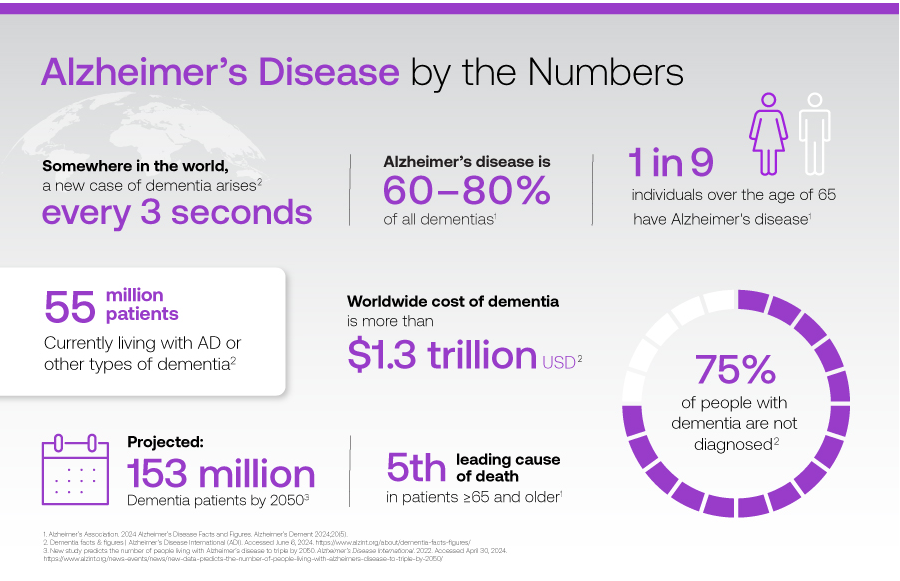
Early diagnosis and intervention can help to improve outcomes for individuals living with Alzheimer’s disease, as well as for their caregivers and families. Currently, the diagnosis of Alzheimer’s disease is made following subjective symptom reporting, cognitive testing, and a series of lab tests that rule out reversible or treatable conditions that can cause cognitive changes. Other testing includes imaging studies such as computerized tomography (CT) scans, magnetic resonance imaging (MRI), and/or positron emission tomography (PET) scans. However, changes in the brain may occur long before clinical symptoms are detected, making early diagnosis of Alzheimer’s disease particularly challenging. Alzheimer’s disease progresses on a spectrum of 3 phases: preclinical, mild cognitive impairment, and then dementia, which is further stratified into mild, moderate, and severe stages. How quickly patients progress through the continuum varies and is influenced by factors including age, environmental factors, genetics, and sex.1A significant step forward in addressing the urgent need for earlier and more accurate detection of Amyloid pathology, a hallmark of Alzheimer’s disease.
Beckman Coutler continues to invest in immunoassay technology to develop new, blood-based, high throughput, high sensitivity assays to detect and measure neurological biomarkers at a scale to address the growing global challenge.
NEW Blood-based Assays (RUO)for Early Alzheimer's Diagnostic
p-Tau217 Assays
Information Bulletin :
Using the new Access p-Tau217 (RUO) assay in your laboratory.
Access p-Tau217 (RUO) assay (REF D14230) for use with the DxI 9000 Immunoassay
Analyzer
GFAP Assays
Information Bulletin:
Using the new Access GFAP (RUO) assay in your laboratory.
Access GFAP (RUO) assay (REF D11672) for use with the Access 2 Immunoassay System and the DxI 9000 Immunoassay Analyzer
NfL Assays
Information Bulletin:
Using the new Access NfL (RUO) assay in your laboratory.
Access NfL (RUO) assay (REF D15673) for use with the Access 2 Immunoassay
System and the DxI 9000 Immunoassay Analyzer
APOE ε4 Assays
Information Bulletin:
Using the new Access APOE
ε
4 (RUO) assay in your laboratory.
Access APOE
ε
4 (RUO) assay (REF D16691) for use with the Access 2 Immunoassay System and the DxI 9000 Immunoassay Analyzer
Beckman Coulter Diagnostics, receives (FDA) Breakthrough Device Designation to Beckman Coulter’s Access p‑Tau217/β-Amyloid 1-42 plasma ratio. This blood test is designed to aid healthcare providers identify patients with amyloid pathology associated with Alzheimer's disease.
2025 Jan28 Bec Receives FDA Breakthrough Device Designation (Beckman)
Scalable Immunoassay Solutions to Match Your Lab
Our RUO neurology assays run on the following Beckman Coulter Immunoassay Analyzers 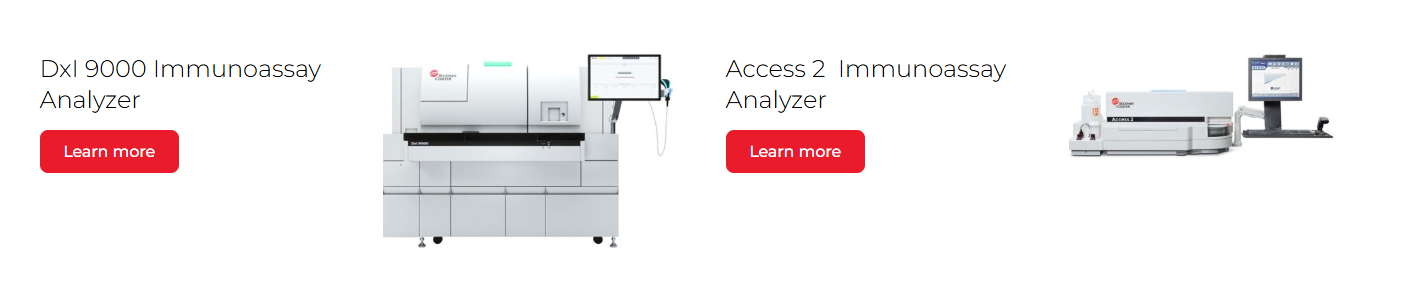
Beckman Coulter Life Sciences, T-NeuroDx Collaborate
on Early Alzheimer's Diagnostics
The collaboration will combine T-NeuroDx's research in Alzheimer's diagnostics with Beckman Coulter's flow cytometry products and is intended to demonstrate the potential of the test to detect an initiating event before dysregulated beta-amyloid and tau, the current standard of care for Alzheimer's biomarker-based diagnostics, are detectable, the company said in a statement.
The neuroimmunology field has long been riddled with complexities which stood in the way of significant advancements, and the introduction of streamlined flow cytometry assays could offer promising new potential for translational research," said our Jean-Marc Busnel, Senior Staff Research Scientist.
Beckman Coulter Life Sciences T Neurodx Collaborate Early (GenomeWeb)
Prepare
Your Lab
to empower
Alzheimer’s
Disease Research
Alzheimer’s disease:
Challenges to diagnosis
and the emerging treatment landscape
Diagnostics And Treatments For Alzheimers (Beckman)
The Role of APOE in Alzheimer's Disease: Genetic Variants, Mechanisms, and Therapeutic Implications
Role of APOE in Alzheimer's Disease