Advancing molecular diagnostics through a technology that is redefining how low‑frequency mutations are being detected. Using equipment that is already readily available in most laboratories.
What is superRCA®?
superRCA is a highly specific molecular amplification technology engineered for ultra-sensitive detection of low-frequency DNA variants in both liquid biopsy and tissue-derived samples.
Request advice from our expert
What is superRCA®?
It's an ultrasensitive multiplex assay for detecting very small amounts of DNA sequence variants such as cancer mutations, in tissue or liquid biopsy samples.
Why superRCA® makes a difference
- Unprecedented ultra-sensitivity of 1 mutation in 100,000 wild types due to the novel combination of the extremely high specificity of Padlock probes and RCA
- Outstanding performance on High GC% targets and sequences
- High multiplexity and assay flexibility for broad applications
- Convenient and reliable analysis by well-established flow cytometry for decentralised use
- Other read-out and analysis methods including fluorescence microscopy
- Speed and cost-effectiveness at high-throughput
- Simple step-by-step manual workflow using standard lab equipment
- Singe tube format, automation ready using liquid dispersion robots
Available as research use only kits and service testing.
Can a standard flow cytometer detect DNA? superRCA makes it possible
superRCA combines molecular analysis with flow cytometry to enable ultra-sensitive mutation detection down to 0.001% VAF (1 mutation in 100,000 wild-type molecules). By leveraging commonly available flow cytometers, superRCA helps make highly sensitive mutation detection accessible to more laboratories, expanding what is possible in precision medicine.
Explore How to Find 1 Mutated Cell in 100,000 Wild-Type Cells
In the
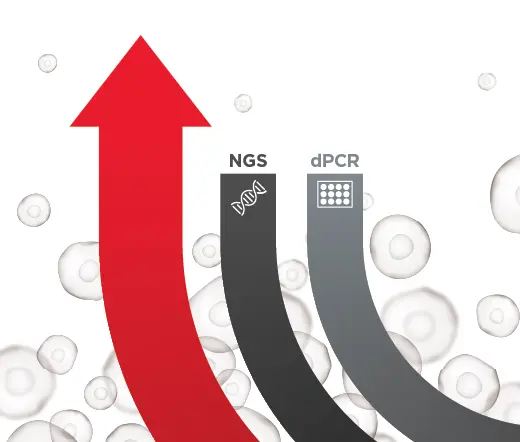
race to detect measurable residual disease (MRD), sensitivity isn’t optional
—it’s a mission-critical factor for your research. Traditional technologies
like NGS and dPCR, while powerful, often fall short in detecting rare, mutated
cells that can signal disease recurrence or treatment resistance in your study.
superRCA® can detect 1 mutation out of 100,000 wild-type DNA molecules.
The remarkable sensitivity of superRCA® is achieved by two consecutive Rolling Circle Amplification (RCA) reactions. A first standard RCA step is followed directly by a subsequent “in situ” Padlock Probing and RCA step. As a result the target region is genotyped with high specificity, enumerated with higher precision.
Ultra-sensitive monitoring of leukemia patients using superRCA® mutation detection assays The method has been published in Nature Communication in a research study on Measurable Residual Disease (MRD) monitoring in Acute Myeloid Leukemia.
Discover why pushing the limits of sensitivity is no
longer optional—it’s essential
For Research Use Only. Not for use in diagnostic
procedures.
Revolutionising molecular research with flow cytometry
Traditional flow cytometry has been primarily utilised for phenotype analysis. However, this new platform integrates a molecular assay based on rolling circle amplification (RCA) and padlock probes, enabling high-sensitivity detection of genetic mutations. By combining these technologies, the superRCA assays provide specific and multiplex detection of sequence variants, including single-point DNA mutations, with precision.
Beyond its high sensitivity, the superRCA assay offers laboratories significant efficiency improvements. With high-throughput capabilities, it delivers faster turnaround times without the need for additional hardware investments. This reduces the barriers to molecular research, making advanced assays more accessible to laboratories worldwide.
Pushing the Limits of Sensitivity
superRCA ® assays are not just another MRD tool—it’s a disruptive technology platform that redefines what’s possible. By enabling ultra-sensitive detection of DNA mutations through flow cytometry, this technology opens a new frontier in MRD research.
This award-winning * method enables you to:
- Detect ultra-sensitive DNA mutations with unmatched specificity
- Leverage the power and scalability of flow cytometry—now for detecting DNA mutations
- Develop next-gen assays that push therapeutic research forward
Elevate your MRD assay development with a tool built for precision.
See How superRCA® Technology Works
From hands-on workflows to automated precision: Biomek + superRCA
See how automated liquid handling support the superRCA workflow, reducing hands-on time while enabling a more streamlined workflow.
By integrating the superRCA assay with Biomek i-series automated liquid handlers from Beckman Coulter s, laboratories can move toward more standardized workflows, making ultra-sensitive mutation detection more accessible in routine research settings.

--------------------------------------------------
Speaking of the agreement, Pietro Lopriore, Vice President and General Manager of the Flow Cytometry Business Unit at Beckman Coulter Life Sciences said:
“This milestone reinforces our relentless commitment to providing cutting-edge and innovative technologies to laboratories while delivering cost and time savings.
This brings a revolutionary new advancement to the field of molecular MRD research. These assays complement our innovative flow cytometry products, such as DURAClone RE MRD panels, to empower laboratories with a richer variety of technologies to expand and expedite their research possibilities to advance human health.”
Linus Bosaeus, CEO of Rarity Bioscience AB, expressed enthusiasm about the partnership, emphasising the scalability and accessibility of superRCA technology.
“It is with great excitement that we are entering into this partnership. Our strategic decision to develop superRCA technology for use with widely adopted flow cytometry platforms was driven by the goal of enabling rapid scalability and providing laboratories and researchers with immediate access to high-precision molecular testing. Partnering with Beckman Coulter Life Sciences, a global leader in flow cytometry, further reinforces this strategy and allows us to focus on expanding our platform’s capabilities within MRD assays and beyond.”
Request advice from our epxert