DIL L75 PT Horizontal Dilatometer
Référence: LINS-DIL L75 horizontal
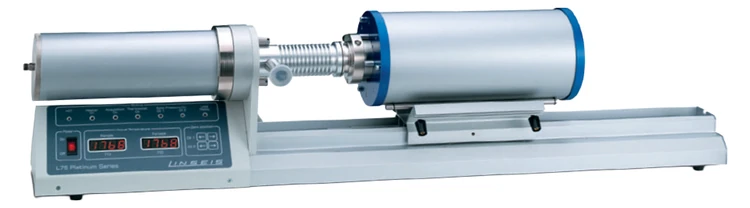
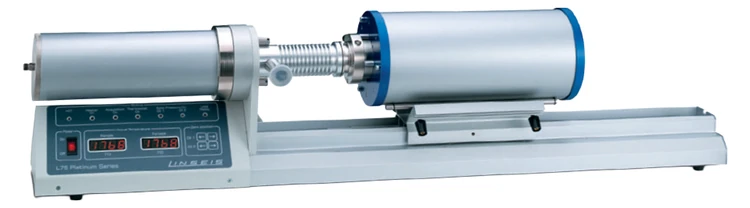
https://www.analis.com/shop/lins-dil-l75-horizontal-dil-l75-pt-horizontal-dilatometer-147778 https://www.analis.com/web/image/product.template/147778/image_1920?unique=ad3a0d8The LINSEIS DIL L75 H is a horizontal pushrod dilatometer developed for academic and research laboratories. It accurately determines the thermal expansion behavior of solids, liquids, powders and pastes across a wide range of applications, with high precision, reproducibility and accuracy, under vacuum and in oxidizing and reducing atmospheres.
What does the DIL L75 H measure?
The L75 H measures thermal expansion and shrinkage and determines many physical properties in one run: CTE (coefficient of thermal expansion), linear thermal expansion, physical alpha, sintering temperature, phase transformations, softening points, decomposition temperatures and glass transition temperatures.
How does it work?
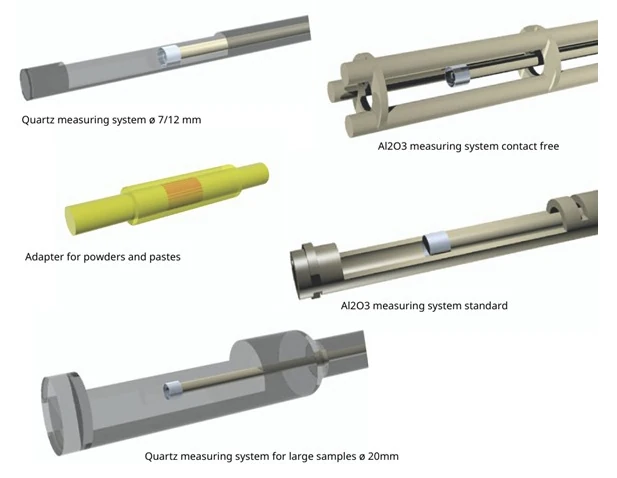
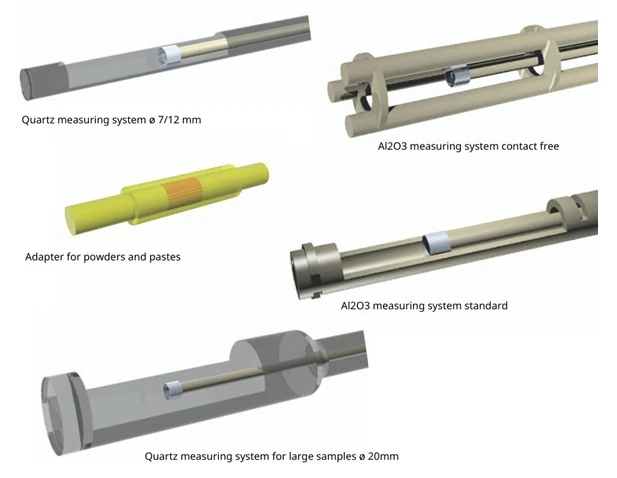
The horizontal pushrod design applies an automatic, continuously variable contact pressure between 10 and 1000 mN, adjustable to the application. Measuring systems are available in fused silica, Al₂O₃ or graphite, in single, dual or quattro configuration, and the instrument comes in single, dual or differential versions for higher precision or sample throughput. Options include sample holders, gas boxes for up to 4 gases, vacuum pumps, Rate Controlled Sintering (RCS) software and a separable mechanics/electronics option for glovebox measurements.
Key advantages
- Single, dual or differential version for even higher precision or sample throughput
- Automatic pressure control with contact pressure continuously variable between 10 and 1000 mN, depending on the application
- Separable mechanics and electronics as an option, to allow measurements in a glovebox
- Measuring systems in fused silica, Al₂O₃ or graphite, in single, dual or quattro configuration
- Wide choice of options such as sample holders, gas boxes for up to 4 gases, vacuum pumps and Rate Controlled Sintering (RCS) software
- Measurement of physical properties: CTE, linear thermal expansion, physical alpha, sintering temperature, phase transformations, softening points, decomposition temperatures and glass transition temperatures
- Data security on power failure and protection against thermocouple break
- Evaluation tools with curve comparison of up to 32 curves, statistical evaluation package and export to MS Excel
Suitable for
- Thermal expansion and shrinkage of solids, liquids, powders and pastes
- Rock crystal (quartz) phase transition with calculated DTA
- CTE studies of metal matrix composites such as CuSiC versus AlSiC
- Dissimilar metal welding of ferritic 1.4742 to austenitic 310S stainless steel
- Thermal properties of alkali-activated metal slag for timber structures
Request a demonstration or quote
Download the brochure below for full specifications. Ask Analis’ local Benelux experts for more information, a demonstration, or a personalized quote.


Données Techniques
Category | Specification |
Temperature range | -180 to 2800 °C |
Delta L resolution | 0.03 nm |
Measuring range | +/- 2500 µm |
Contact force | 10 mN to 1 N |
Delta L resolution (second value in source) | 0.1 nm |
Automatic detection of sample length | Yes |
Force modulation | Yes |
Contact force (second value in source) | 10 mN to 5 N |
Multiple furnace configuration | Maximum 2 furnaces |
Motorized furnace operation | Optional |
Gas dosing | Manual gas dosing or mass flow controller for 1/3 or more gases |
Contact force adjustment | Included |
Single/dual dilatometer | Optional |
Detection of processing points | Included |
Density determination | Included |
L-DTA | Optional (up to 2000 °C) |
Options and Accessories
- Different types (designs/materials) of sample holders
- Caliper for online entry of the sample length
- Choice of manual, semi-automatic and automatic (MFC) gas boxes for up to 4 gases
- Instruments for sample preparation
- Software option for Rate Controlled Sintering (RCS)
- Various rotary and turbomolecular pumps
- Option to operate under H2
Accessories and Software
All LINSEIS thermal analysis instruments are PC-controlled. The individual software modules run exclusively under Microsoft® Windows® operating systems. The complete software consists of 3 modules: temperature control, data acquisition and data evaluation. The software contains all essential functions for preparing, running and evaluating a dilatometer measurement.
- Text-editing program
- Data protection on power failure
- Thermocouple break protection
- Repeat measurements with minimal parameter input
- Evaluation of ongoing measurement
- Curve comparison of up to 32 curves
- Storage and export of evaluations
- ASCII data export and import
- Data export to MS Excel
- Analysis with multiple methods (DSC, TG, TMA, DIL, etc.)
- Zoom function
- 1st and 2nd derivative
- Programmable gas control
- Statistical evaluation package
- Free scaling
DIL Functions
- Evaluation of glass transition and softening point
- Softening point detection with automatic software-controlled system shutdown
- Display of relative/absolute shrinkage or expansion curves
- Presentation and calculation of the technical / physical expansion coefficient
- Rate Controlled Sintering (RCS) software
- Evaluation of the sintering process
- Semi-automatic evaluation functions
- Various system correction functions
- Automatic zero-point adjustment
- Automatic software-controlled adjustment of the sample pressure
Comparison of LVDT and Linear Optical Encoder
The LVDT (Linear Variable Differential Transformer) consists of 3 coils: the LVDT body and the movable core. The primary coil is excited by a low-frequency AC voltage. The two secondary coils are connected in series with opposite polarity. The horizontal position of the core defines the degree of coupling between the primary and secondary coils.
When the core is in the middle position, the voltages induced in the secondary coils have the same amplitude. Because of the opposite polarity of the two coils, the sum (output voltage) is zero. When the core moves, the coupling between primary and secondary coils changes. The induced voltage increases in one secondary coil and decreases in the other, so the sum of both is no longer zero. The amplitude of the sum depends on the amount of core movement, while the phase (polarity) depends on the direction of movement.
Advantages of LVDT
- The output signal is absolute and unique for every position, no reference movement is needed
- The core can move without any friction
- The resolution is infinite, limited only by the noise of the electronics used for signal conditioning
- Insensitive and better suited to applications in dirty environments (gas, vacuum, dust)
Disadvantages of LVDT
- More limited measuring range, e.g. +/- 2.5 mm
- Calibration needed
A linear optical encoder uses a scale made of glass or metal with a special optical pattern. Usually transparent and non-transparent lines, or reflecting and non-reflecting lines, are used. A light source shines on the scale and the light/dark transitions are measured. The number of transitions measured corresponds to the displacement, while the phase contribution of the two detectors A and B depends on the direction of movement.
Advantages of linear optical encoder
- No calibration needed
- No limit on measuring range
- Force modulation, offering TMA capabilities
- Superior reproducibility
Disadvantages of linear optical encoder
- The change in position is measured relatively; an absolute position measurement requires a zero-position measurement
- Limited resolution: the lower limit for the pattern spacing on the scale is approximately 20 nm. For higher resolutions, the readout must be interpolated
- The optical detection system is sensitive to dust (production environment)
Application Examples
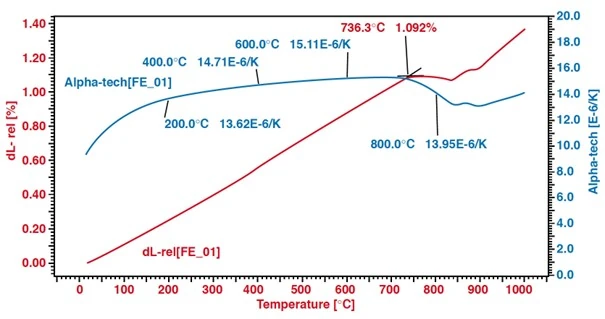
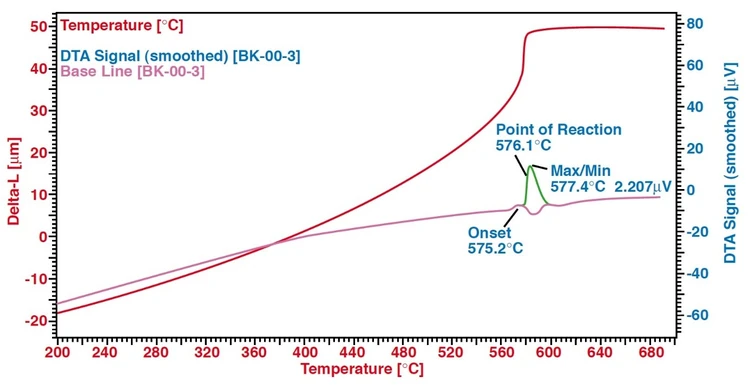
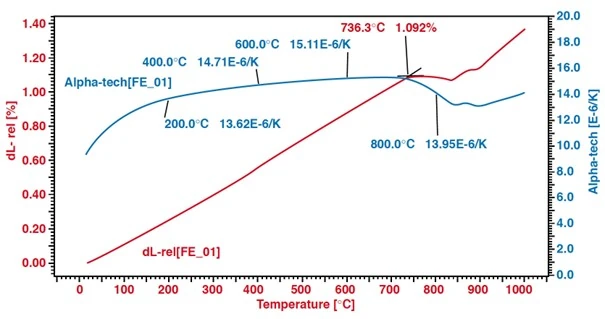
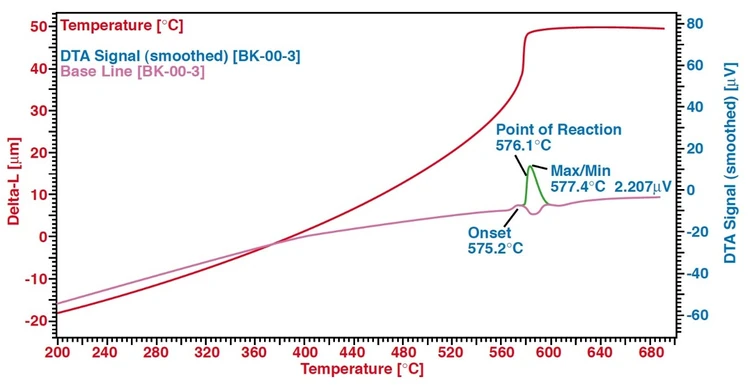
Rock crystal (calculated DTA). The thermal expansion of rock crystal is easily evaluated with the L75 dilatometer. The additional DTA function gives deeper insight into the thermal behavior of the material. The DTA measurement is a mathematical routine based on the sample temperature. Exothermic and endothermic effects influence the change in sample temperature during the dynamic heating or cooling cycle. The phase transition takes place at approximately 575 °C. The deviation of the measured temperature from the literature value (574 °C) can be used for temperature calibration. The linear thermal expansion (delta L) and the CTE of the sample under argon atmosphere are evaluated. The heating rate was 5 K/min. After 736.3 °C (peak temperature of the CTE), shrinkage was detected, which results from a change in atomic structure known as the Curie point. The difference between the measured and the literature result can be attributed to contamination of the sample.
Published studies using the instrument:
- Dissimilar metal welding of 1.4742 ferritic to 310S austenitic stainless steel using different filler metals (published in Metallography, Microstructure, and Analysis)
- Investigation of the coefficient of thermal expansion (CTE) in metal matrix composites of CuSiC versus AlSiC (published in IOP Conference Series: Materials Science and Engineering)
- Thermal properties of alkali-activated metal slag for timber structures (published in Scientific Reports)