- ADN / ARN (acides nucléiques)
- Agitateurs et shakers
- Agrégation plaquettaire
- Analyse cellulaire
- Analyse de l'humidité
- Analyse thermique
- Analyse urinaire
- Caractérisation des particules
- Centrifugation
- Chauffage et refroidissement
- Chimie analytique
- Chimie clinique
- Chromatographie flash & préparative
- Contrôle environnemental
- Contrôles de qualité cliniques
- Couleur-Apparence et tests physiques
- Culture cellulaire et fermentation
- Cytométrie en flux
- Désinfection
- Electrophorèse capillaire
- Essais et caractérisation des matériaux
- Fécondation in vitro (FIV)
- Hottes de Protection
- Hématologie
- Imagerie biologique
- Immuno-hématologie
- Immunoassay
- Lyophilisation
- Microbiologie (clinique)
- Microscopie
- Mobilier de laboratoire et études de conception
- Métrologie
- Nephelometry (Néphélométrie)
- Nettoyage Lavage
- POCT
- Pesage
- Pipetage de liquides (manuel)
- Pompes
- Préparation d'échantillon
- Purification de l'eau
- Rhéomètres
- Robot de pipetage
- Solutions d'automatisation clinique (TLA)
- Solutions informatiques cliniques
- Spectromètres de masse
- Stockage
- Stérilisation
- Synthèse
- Tests sur tablettes
- Texturomètres
- Toxicologie
- Tri cellulaire par Cytométrie en flux
- Viscosimètres
- Électrochimie
- Analyse thermique Calorimétrie différentielle à balayage (DSC)
- DSCPT 1600 High-Temperature DSC
HOME / APPLICATIONS & TECHNIQUES /
DSCPT 1600 High-Temperature DSC
Référence: LINS-DSC L62
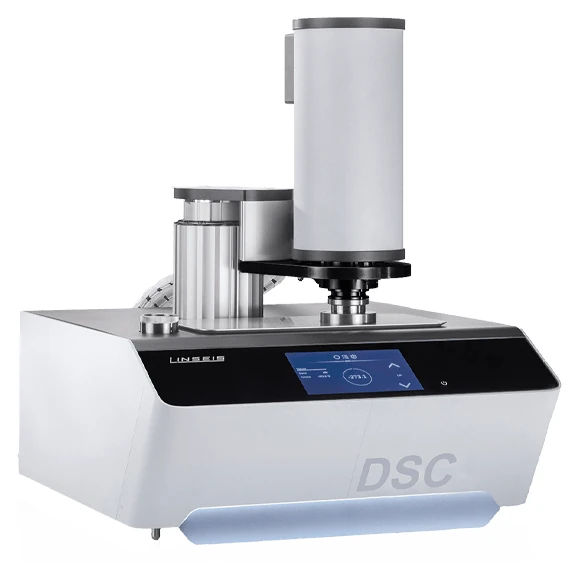
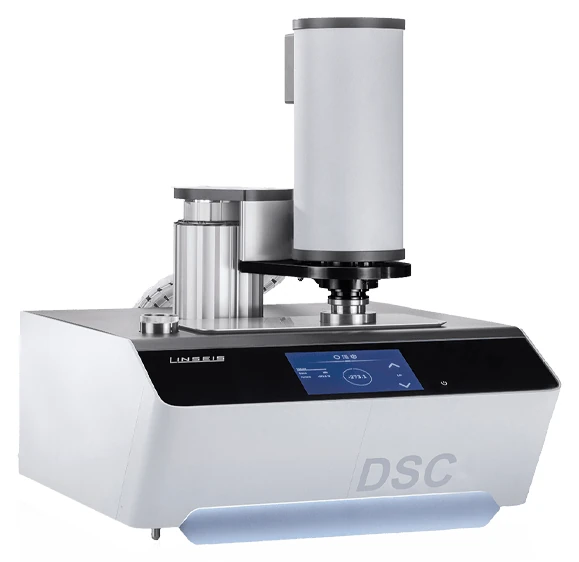
https://www.analis.com/shop/lins-dsc-l62-dscpt-1600-high-temperature-dsc-147781 https://www.analis.com/web/image/product.template/147781/image_1920?unique=ad3a0d8Differential Scanning Calorimetry (DSC) is the most widely used thermal analysis method, thanks to the breadth of information it provides. The LINSEIS DSC PT 1600 (HDSC/DTA) is a high-temperature DSC designed for the highest calorimetric sensitivity, short time constants and a condensation-free sample chamber, delivering superior resolution and baseline stability throughout the instrument’s lifetime.
It is built for materials development, R&D and quality control, with a temperature range reaching 1750 °C.
What does the DSC PT 1600 measure?
As a Heat-Flux DSC / DTA, the PT 1600 measures heat flow to characterize thermal transitions, enthalpy and specific heat (Cp). Its vacuum-tight design allows quantitative enthalpy and Cp determination under the cleanest atmospheres and down to a vacuum of 10⁻⁵ mbar, which is essential for exact calorimetric results on demanding materials.
How does it work?
A modular concept accepts different furnaces across a temperature range of −150 °C to 1750 °C, so one platform covers low- and high-temperature calorimetry. High calorimetric sensitivity and short time constants give a stable baseline with very low noise, and the instrument supports temperature-modulated DSC and signal-controlled measurement procedures. Optional add-ons include a sample robot and coupling to MS or FTIR for evolved-gas analysis.
Key advantages
- High calorimetric sensitivity with short time constants
- Condensation-free sample chamber for resolution and baseline stability over the instrument lifetime
- Modular concept allowing different furnaces with a temperature range of −150 °C to 1750 °C
- Vacuum-tight design for quantitative enthalpy and Cp (specific heat) determination under the cleanest atmospheres and under a vacuum of 10⁻⁵ mbar
- Optional sample robot and coupling to MS or FTIR
- Temperature-modulated DSC and signal-controlled measurement procedures
Suitable for
- Materials development
- R&D
- Quality control
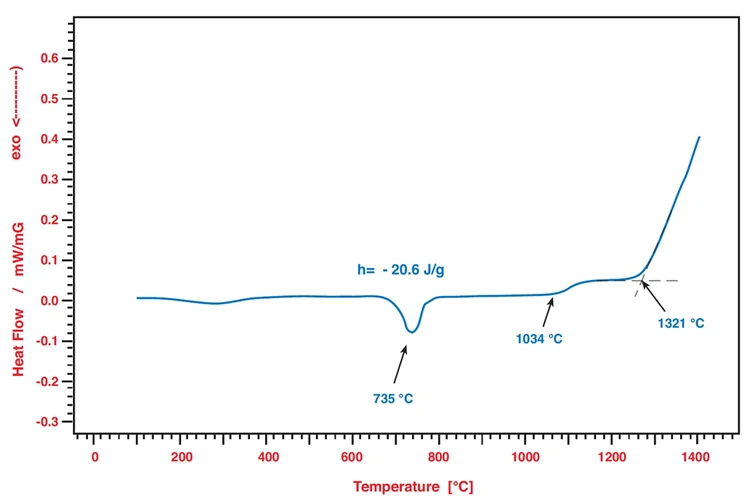
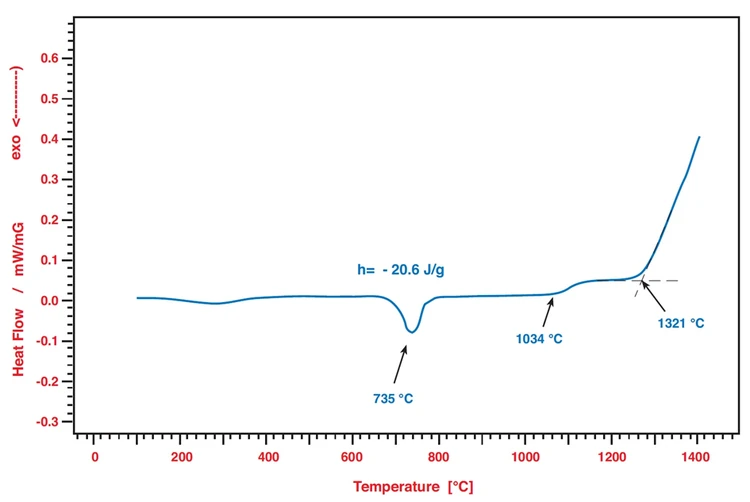
- Ferrite production: magnetic ferrites are made from ZnO, Fe₂O₃ and Cr₂O₃, with Cr₂O₃ added to modify magnetic and electrical properties. At 735 °C the powder forms a mixed ferrite (exothermic reaction: −20.6 J/g). Above 1034 °C and 1321 °C the heat flow deviates strongly in the endothermic direction as several phases melt. With the type S measuring head, the DSC PT 1600 gives a very stable baseline with extremely low noise up to 1450 °C, essential for exact enthalpy measurements and evaluations
Request a demonstration or quote
Ask Analis’ local Benelux experts for more information, a demonstration, or a personalized quote.
Données Techniques
Category | Specification |
Temperature range | -150°C to 700°C, RT to 1600/1750°C |
Sensors | E/K/S/B |
Sensor types | DTA / DSC / DSC – Cp |
Heating rates | 0.001 K/min … 50 K/min |
Cooling rates | 0.001 K/min … 50 K/min |
Measuring range | +/- 2.5 mW to +/- 250 mW |
Sensor | Heat flux |
Temperature modulation | Yes |
Atmospheres | Reducing, oxidizing, inert (static, dynamic) |
Vacuum | 10-5 mbar |
PC interface | USB |
Software
All LINSEIS thermal analysis instruments are PC-controlled and the individual software modules run exclusively under Microsoft Windows operating systems. The complete software consists of 3 modules: temperature control, data acquisition and data evaluation.
For a DSC run, the software has all essential functions for preparing, running and evaluating measurements, as with other thermal analysis experiments. LINSEIS specialists and application experts developed this easy-to-understand and highly practical software.
General Software Features
- Temperature-modulated DSC
- Repeat measurements with minimal parameter input
- Evaluation of current measurement
- Curve comparison of up to 32 curves
- Curve subtraction
- Multi-method analysis (DSC TG, TMA, DIL, etc.)
- Zoom function
- 1st and 2nd derivative
- Multiple smoothing functions
- Complex peak evaluation
- Multi-point calibration for sample temperature
- Multi-point calibration for enthalpy change
- Cp calibration for heat flow
- Storage and export of evaluations
- Text editing program
- ASCII data export and import
- Data export to MS Excel
- Signal-controlled measurement procedures
- Undo function
Agitateurs et shakers
Agrégation plaquettaire
Analyse cellulaire
Analyse de l'humidité
Analyse thermique
Analyse urinaire
Caractérisation des particules
Centrifugation
Chauffage et refroidissement
Chimie analytique
Chimie clinique
Chromatographie flash & préparative
Contrôle environnemental
Contrôles de qualité cliniques
Couleur-Apparence et tests physiques
Culture cellulaire et fermentation
Cytométrie en flux
Désinfection
Electrophorèse capillaire
Essais et caractérisation des matériaux
Fécondation in vitro (FIV)
Hottes de Protection
Hématologie
Imagerie biologique
Immuno-hématologie
Immunoassay
Lyophilisation
Microbiologie (clinique)
Microscopie
Mobilier de laboratoire et études de conception
Métrologie
Nephelometry (Néphélométrie)
Nettoyage Lavage
POCT
Pesage
Pipetage de liquides (manuel)
Pompes
Préparation d'échantillon
Purification de l'eau
Rhéomètres
Robot de pipetage
Solutions d'automatisation clinique (TLA)
Solutions informatiques cliniques
Spectromètres de masse
Stockage
Stérilisation
Synthèse
Tests sur tablettes
Texturomètres
Toxicologie
Tri cellulaire par Cytométrie en flux
Viscosimètres
Électrochimie