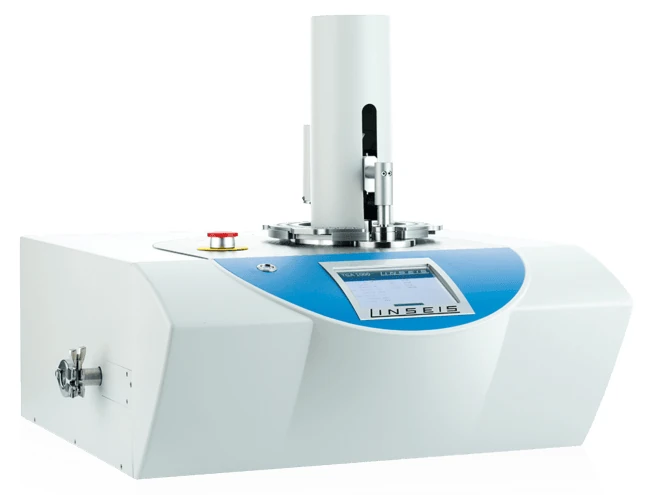
Chip-DSC 100 Differential Scanning Calorimeter
Référence: LINS-DSC L66 Ultimate
https://www.analis.com/shop/lins-dsc-l66-ultimate-chip-dsc-100-differential-scanning-calorimeter-147776 https://www.analis.com/web/image/product.template/147776/image_1920?unique=ad3a0d8The LINSEIS Chip-DSC 100 combines chip sensor technology with the capabilities of LINSEIS’s established DSC range, in a highly modular Heat Flux DSC. Options such as a 96-position sample robot, UV attachment and Raman spectroscopy make it a versatile research-grade instrument, while the low-mass chip delivers excellent temperature control and heating rates up to 1000 K/min.
What does the Chip-DSC 100 measure?
As a Heat-Flux DSC, the Chip-DSC 100 characterizes thermal transitions such as glass transition, crystallization and melting, with high sensitivity and a short time constant. For example, PET granulate heated, quenched and measured at 50 °C/min shows the glass transition at 77 °C, recrystallization at 170 °C and the melting peak at 295 °C. Superior raw data allows direct analysis without pre- or post-processing.
What makes the Chip-DSC 100 so versatile?
Modularity is its defining strength. A 96-position sample robot and a choice of cooling systems support high-throughput work, and a wide range of DSC configurations extends the application scope: high-pressure DSC for OIT stability tests (ageing of polymers, oils and greases), photo DSC for fast UV curing (reactions under one second), plus optical, UV and Raman options and low-temperature DSC. Power consumption is up to 80% lower than standard DSC instruments.
Key advantages
- Chip sensor design with low mass for excellent temperature control and heating rates up to 1000 K/min
- Superior reproducibility from the chip sensor setup and high-quality raw data, allowing direct analysis without pre- or post-processing of heat flow data
- Heat Flux DSC with integrated heater and temperature sensor for high sensitivity, short time constant and fast heating and cooling rates
- High resolution and separation of overlapping effects
- User-exchangeable sensor available at low cost
- Low power consumption, up to 80% less than standard DSC instruments
- Wide range of options including high-pressure, optical, photo, Raman and low-temperature DSC
- Sample robot with 96 positions and a choice of cooling systems
Suitable for
- Polymer analysis: glass transitions, melting points and crystallization points
- OIT stability tests: monitoring the ageing of polymers, oils and greases (high-pressure cell)
- UV curing systems: fast UV curing reactions on a timescale of less than one second (photo DSC)
- PET granulate: heated, quenched and measured at 50 °C/min, glass transition at 77 °C, recrystallization at 170 °C, melting peak at 295 °C
Request a demonstration or quote
Download the brochure below for full specifications. Ask Analis’ local Benelux experts for more information, a demonstration, or a personalized quote.
Données Techniques
Hardware Options
- High-pressure DSC The 50/150 bar high-pressure cell enables OIT stability tests to monitor the ageing of polymers, oils and greases. High-pressure processes such as sorption and chemical reactions can be simulated and optimized.
- Optical DSC A CCD camera lets you observe the sample during the measurement, giving deeper insight into phase transitions and decomposition processes.
- Photo DSC The photocell enables measurements under UV light to study UV curing systems. Thanks to the very short time constant of the chip sensor, fast UV curing reactions on a timescale of less than one second can be measured.
- Raman DSC Raman spectroscopy option (see flags).
- Sample robot DSC The sample robot for up to 96 samples raises productivity considerably. The instrument can run automatically overnight or at weekends. Together with the intuitive and intelligent software, it lowers labor costs and saves time.
- Low-temperature DSC Cooling is available with an intracooler, liquid nitrogen cooling or a Peltier cooling system. The temperature range at ambient conditions can be extended to -180°C.
Software
The new Rhodium software improves your workflow, because its intuitive data processing needs only minimal parameter input.
- AutoEval guides the user through the evaluation of standard processes such as glass transitions or melting points
- Thermal library product identification tool with a database of 600 polymers for automatic identification of your tested polymer
- Mobile control: instrument control and/or monitoring via mobile devices
Software package features
- Linseis LFA 500 software
- Software packages compatible with the latest Windows operating system
- Menu items can be set up
- All specific measurement parameters (user, laboratory, sample, company, etc.)
- Optional password and user levels
- Undo and Redo function for all steps
- Unlimited heating, cooling or dwell-time segments
- Multiple language versions such as English, German, French, Spanish, Chinese, Japanese, Russian, etc. (user selectable)
- Evaluation software with functions that allow a complete evaluation of all types of data
- Multiple smoothing models
- Full evaluation history (all steps can be undone)
- Evaluation and data acquisition can run simultaneously
- Data can be corrected using zero and calibration correction
- Data evaluation includes: peak separation software, signal correction and smoothing, first and second derivatives, curve arithmetic, data peak evaluation, glass point evaluation, slope correction, zoom / individual segment display, multiple curve overlay, annotation and drawing tools, copy-to-clipboard function, multiple export functions for graphics and data export, and reference-based correction