- ADN / ARN (acides nucléiques)
- Agitateurs et shakers
- Agrégation plaquettaire
- Analyse cellulaire
- Analyse de l'humidité
- Analyse thermique
- Analyse urinaire
- Caractérisation des particules
- Centrifugation
- Chauffage et refroidissement
- Chimie analytique
- Chimie clinique
- Chromatographie flash & préparative
- Contrôle environnemental
- Contrôles de qualité cliniques
- Couleur-Apparence et tests physiques
- Culture cellulaire et fermentation
- Cytométrie en flux
- Désinfection
- Electrophorèse capillaire
- Essais et caractérisation des matériaux
- Fécondation in vitro (FIV)
- Hottes de Protection
- Hématologie
- Imagerie biologique
- Immuno-hématologie
- Immunoassay
- Lyophilisation
- Microbiologie (clinique)
- Microscopie
- Mobilier de laboratoire et études de conception
- Métrologie
- Nephelometry (Néphélométrie)
- Nettoyage Lavage
- POCT
- Pesage
- Pipetage de liquides (manuel)
- Pompes
- Préparation d'échantillon
- Purification de l'eau
- Rhéomètres
- Robot de pipetage
- Solutions d'automatisation clinique (TLA)
- Solutions informatiques cliniques
- Spectromètres de masse
- Stockage
- Stérilisation
- Synthèse
- Tests sur tablettes
- Texturomètres
- Toxicologie
- Tri cellulaire par Cytométrie en flux
- Viscosimètres
- Électrochimie
- Analyse thermique Conductivité thermique
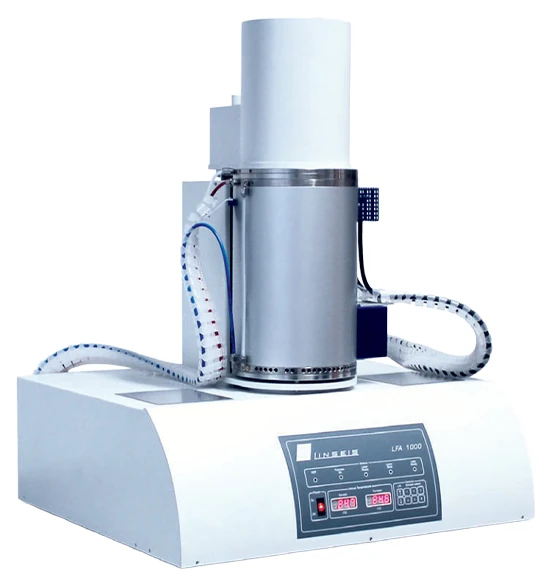
- LFA 1000 Laser Flash Analyzer
HOME / APPLICATIONS & TECHNIQUES /
LFA 1000 Laser Flash Analyzer
Référence: LINS-LFA L52
https://www.analis.com/shop/lins-lfa-l52-lfa-1000-laser-flash-analyzer-147786 https://www.analis.com/web/image/product.template/147786/image_1920?unique=ad3a0d8The LINSEIS LFA 1000 is a highly modular laser flash analyzer (LFA) for determining thermal diffusivity, thermal conductivity and specific heat. A contactless measurement principle and interchangeable furnaces make it accurate across a very wide temperature range.
What does the LFA 1000 measure?
The LFA 1000 measures thermal diffusivity, from which thermal conductivity and specific heat are derived, on solids, liquids, melts and slags. A short energy pulse heats one face of the sample, and the temperature rise on the opposite face is recorded; the speed of that rise gives the thermal diffusivity. It also performs multilayer analysis of 2- or 3-layer systems, including contact-resistance determination.
How does it work?
The temperature rise is measured contactlessly by IR detection (InSb or MCT), which avoids thermocouple contact errors. Three interchangeable furnaces cover a temperature range of −125 to 2800 °C, and an automated sample robot handles 3, 6 or 18 samples at once for fast turnaround. Advanced evaluation models, including pulse-length correction, heat-loss correction and the Dusza model, ensure accurate results, with a fully automated procedure for multi-sample runs.
Key advantages
- Different sample holders for solids, liquids, melts and slags
- Automated sample robot handling 3, 6 or 18 samples at the same time for exceptionally fast turnaround
- Three interchangeable furnaces for measurements over a wide temperature range of −125 to 2800 °C
- Contactless temperature-rise measurement via IR (InSb or MCT) detection
- Advanced evaluation models including pulse-length correction, heat-loss correction and the Dusza model
- Multilayer analysis of 2- or 3-layer systems, including contact-resistance determination
- Fully automated measurement procedure for multi-sample measurements
Suitable for
- Solids, liquids, melts and slags
- Electronic packaging and heat sinks
- Brackets and reactor cooling
- Heat exchangers and thermal insulators
- Glass-ceramics: Pyroceram, a Corning glass-ceramic often used as a standard, was tested with the LFA 1000 to confirm reproducibility of thermal diffusivity measurements. 18 measurements on 18 samples from a single bulk block, each analyzed separately, showed a variation of only ±1% up to 1250 °C
Request a demonstration or quote
Download the brochure below for full specifications. Ask Analis’ local Benelux experts for more information, a demonstration, or a personalized quote.
Données Techniques
Category | Specification |
Temperature range |
|
Temperature rise measurement | Contactless via IR (InSb or MCT) detection |
Thermal diffusivity measuring range | 0.01 mm2/s up to 2000 mm2/s |
Thermal conductivity measuring range | 0.1 W/mK up to 3500 W/mK |
Sample size | ∅ 6, 10, 12.7 … 25.4 mm, square 10×10 or 20×20 mm |
Sample thickness | 0.1 mm … 6 mm |
Software
All LINSEIS thermal analysis instruments are controlled by a PC. The individual software modules run exclusively under Microsoft® Windows® operating systems. The complete software consists of three modules: temperature control, data acquisition and data evaluation. The Linseis 32-bit software offers all essential functions for preparing, running and evaluating measurements, as with other thermal analysis experiments.
LFA Functions
- Accurate pulse length correction, pulse mapping
- Heat loss corrections
- Analysis of 2- or 3-layer systems
- Dusza model for simultaneous finite pulse and heat loss correction
- Wizard for selecting the perfect evaluation model
- Determination of specific heat
- Determination of contact resistance in multilayer systems
Evaluation Software
- Automatic or manual entry of related measurement data (density, specific heat)
- Model wizard for selecting the right model
- Finite pulse correction
- Heat loss correction
- Multilayer model
- Contact resistance determination
- Cp (specific heat) determination by comparative method
Measurement Software
- Simple and user-friendly data entry for temperature segments, gases, etc.
- Controllable sample robot
- Software automatically displays corrected measurements after the energy pulse
- Fully automated measurement procedure for multi-sample measurements
Agitateurs et shakers
Agrégation plaquettaire
Analyse cellulaire
Analyse de l'humidité
Analyse thermique
Analyse urinaire
Caractérisation des particules
Centrifugation
Chauffage et refroidissement
Chimie analytique
Chimie clinique
Chromatographie flash & préparative
Contrôle environnemental
Contrôles de qualité cliniques
Couleur-Apparence et tests physiques
Culture cellulaire et fermentation
Cytométrie en flux
Désinfection
Electrophorèse capillaire
Essais et caractérisation des matériaux
Fécondation in vitro (FIV)
Hottes de Protection
Hématologie
Imagerie biologique
Immuno-hématologie
Immunoassay
Lyophilisation
Microbiologie (clinique)
Microscopie
Mobilier de laboratoire et études de conception
Métrologie
Nephelometry (Néphélométrie)
Nettoyage Lavage
POCT
Pesage
Pipetage de liquides (manuel)
Pompes
Préparation d'échantillon
Purification de l'eau
Rhéomètres
Robot de pipetage
Solutions d'automatisation clinique (TLA)
Solutions informatiques cliniques
Spectromètres de masse
Stockage
Stérilisation
Synthèse
Tests sur tablettes
Texturomètres
Toxicologie
Tri cellulaire par Cytométrie en flux
Viscosimètres
Électrochimie