- ADN / ARN (acides nucléiques)
- Agitateurs et shakers
- Agrégation plaquettaire
- Analyse cellulaire
- Analyse de l'humidité
- Analyse thermique
- Analyse urinaire
- Caractérisation des particules
- Centrifugation
- Chauffage et refroidissement
- Chimie analytique
- Chimie clinique
- Chromatographie flash & préparative
- Contrôle environnemental
- Contrôles de qualité cliniques
- Couleur-Apparence et tests physiques
- Culture cellulaire et fermentation
- Cytométrie en flux
- Désinfection
- Electrophorèse capillaire
- Essais et caractérisation des matériaux
- Fécondation in vitro (FIV)
- Hottes de Protection
- Hématologie
- Imagerie biologique
- Immuno-hématologie
- Immunoassay
- Lyophilisation
- Microbiologie (clinique)
- Microscopie
- Mobilier de laboratoire et études de conception
- Métrologie
- Nephelometry (Néphélométrie)
- Nettoyage Lavage
- POCT
- Pesage
- Pipetage de liquides (manuel)
- Pompes
- Préparation d'échantillon
- Purification de l'eau
- Rhéomètres
- Robot de pipetage
- Solutions d'automatisation clinique (TLA)
- Solutions informatiques cliniques
- Spectromètres de masse
- Stockage
- Stérilisation
- Synthèse
- Tests sur tablettes
- Texturomètres
- Toxicologie
- Tri cellulaire par Cytométrie en flux
- Viscosimètres
- Électrochimie
- Analyse thermique Conductivité thermique
- TF-LFA L54 Thin Film Analyzer
HOME / APPLICATIONS & TECHNIQUES /
TF-LFA L54 Thin Film Analyzer
Référence: LINS-TF-LFA L54
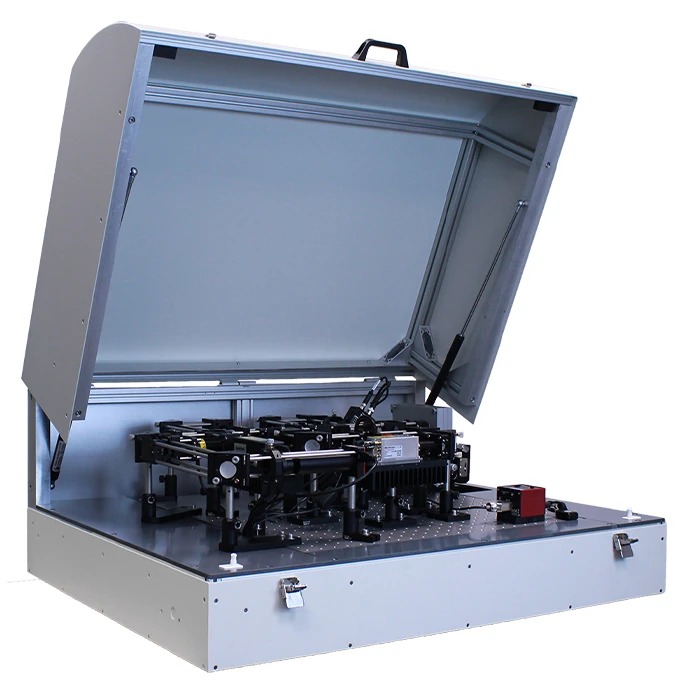
https://www.analis.com/shop/lins-tf-lfa-l54-tf-lfa-l54-thin-film-analyzer-147797 https://www.analis.com/web/image/product.template/147797/image_1920?unique=ad3a0d8The LINSEIS TFA-LFA L54 is a thin film analyzer for characterizing the thermophysical properties of films in the nm to µm range. Because the physical properties of thin films differ from those of bulk materials, this data is essential for accurate thermal management predictions and for optimizing heat transfer in end products.
What does the TFA-LFA L54 measure?
The L54 characterizes the thermophysical properties of thin films on samples from a few nanometres to several micrometres thick, across a wide material range, semiconductors, metals, ceramics and organic substances. All measurements are taken in one run on the same sample, with high flexibility in sample thickness, resistance and deposition method.
How does it work?
The L54 is a chip-based measuring device that uses pre-structured chips as consumables for easy sample preparation and handling. Temperature-dependent measurements run from RT up to 500 °C, so you can study how thin-film properties change with temperature on a single, compact system.
Key advantages
- High-quality, easy-to-use characterization system for thin films (nm to µm range)
- Temperature-dependent measurements from RT up to 500 °C
- Easy sample preparation and handling
- Chip-based measuring device with pre-structured chips as consumables
- High measurement flexibility regarding sample thickness, sample resistance and deposition methods
- All measurements in one run on the same sample
- Wide material range: semiconductors, metals, ceramics and organic substances
Suitable for
Thin films are used across many industries, including:
- Optical phase-change disc media
- Thermoelectric materials
- Light-emitting diodes (LEDs) and flat panel displays
- Phase-change memories
- Semiconductors
- Fuel cells
- Thermal barrier coatings and optical coatings
Request a demonstration or quote
Download the brochure below for full specifications. Ask Analis’ local Benelux experts for more information, a demonstration, or a personalized quote.
Données Techniques
Category | Specification |
Temperature range | RT to 500°C |
Pump laser | Nd: CW Laser (405 nm, 300 mW) |
Probe laser | CW Laser (532 nm), 25 mW |
Thermal diffusivity measuring range | 0.01 mm²/s to 1000 mm²/s |
Sample thickness | 80nm to 20 µm |
Atmospheres | Inert, oxidizing, reducing |
Thin Films
Thin films are materials with a thickness of nanometers to micrometers applied to surfaces. Their thermophysical properties differ considerably from those of bulk materials, depending on thickness and temperature. They are mostly used in semiconductors, LEDs, fuel cells and optical storage media. All these industries deposit a film on a substrate to give a device a certain function.
The flash method has developed over past decades into the most widely used technique for measuring the thermal diffusivity and thermal conductivity of various types of solids, powders and liquids.
Types of thin films
- Thin film: layer of a few nm to µm
- Films grown on a specific substrate
- Typical growth techniques: PVD (e.g. sputtering, thermal evaporation); CVD (PECVD, LPCVD, ALD); drop casting, spin coating and printing
- Film types include: semiconducting films (e.g. thermoelectric, sensors, transistors), metal films (used as contacts), thermal barrier coatings and optical coatings
Accessories and/or Software
All LINSEIS thermal analysis instruments are PC-controlled, and the individual software modules run exclusively under Microsoft® Windows® operating systems. The complete software consists of 3 modules: temperature control, data acquisition and data evaluation. The Linseis 32-bit software has all the essential features for preparing, running and evaluating measurements, as for other thermal analysis experiments.
General features
- Fully compatible MS® Windows™ 32-bit software
- Data protection in case of power failure
- Protection against thermocouple break
- Evaluation of current measurement
- Curve comparison
- Storage and export of evaluations
- Export and import of data in ASCII
- Data export to MS Excel
Evaluation software
- Automatic or manual entry of related measurement data: (density), Cp (specific heat)
- Model wizard for selecting the correct model
- Determination of contact resistance
- Sensitivity diagram
Measurement software
- Simple and user-friendly data entry for temperature segments, gases, etc.
- Fully automated measurement
Agitateurs et shakers
Agrégation plaquettaire
Analyse cellulaire
Analyse de l'humidité
Analyse thermique
Analyse urinaire
Caractérisation des particules
Centrifugation
Chauffage et refroidissement
Chimie analytique
Chimie clinique
Chromatographie flash & préparative
Contrôle environnemental
Contrôles de qualité cliniques
Couleur-Apparence et tests physiques
Culture cellulaire et fermentation
Cytométrie en flux
Désinfection
Electrophorèse capillaire
Essais et caractérisation des matériaux
Fécondation in vitro (FIV)
Hottes de Protection
Hématologie
Imagerie biologique
Immuno-hématologie
Immunoassay
Lyophilisation
Microbiologie (clinique)
Microscopie
Mobilier de laboratoire et études de conception
Métrologie
Nephelometry (Néphélométrie)
Nettoyage Lavage
POCT
Pesage
Pipetage de liquides (manuel)
Pompes
Préparation d'échantillon
Purification de l'eau
Rhéomètres
Robot de pipetage
Solutions d'automatisation clinique (TLA)
Solutions informatiques cliniques
Spectromètres de masse
Stockage
Stérilisation
Synthèse
Tests sur tablettes
Texturomètres
Toxicologie
Tri cellulaire par Cytométrie en flux
Viscosimètres
Électrochimie