- ADN / ARN (acides nucléiques)
- Agitateurs et shakers
- Agrégation plaquettaire
- Analyse cellulaire
- Analyse de l'humidité
- Analyse thermique
- Analyse urinaire
- Caractérisation des particules
- Centrifugation
- Chauffage et refroidissement
- Chimie analytique
- Chimie clinique
- Chromatographie flash & préparative
- Contrôle environnemental
- Contrôles de qualité cliniques
- Couleur-Apparence et tests physiques
- Culture cellulaire et fermentation
- Cytométrie en flux
- Désinfection
- Electrophorèse capillaire
- Essais et caractérisation des matériaux
- Fécondation in vitro (FIV)
- Hottes de Protection
- Hématologie
- Imagerie biologique
- Immuno-hématologie
- Immunoassay
- Lyophilisation
- Microbiologie (clinique)
- Microscopie
- Mobilier de laboratoire et études de conception
- Métrologie
- Nephelometry (Néphélométrie)
- Nettoyage Lavage
- POCT
- Pesage
- Pipetage de liquides (manuel)
- Pompes
- Préparation d'échantillon
- Purification de l'eau
- Rhéomètres
- Robot de pipetage
- Solutions d'automatisation clinique (TLA)
- Solutions informatiques cliniques
- Spectromètres de masse
- Stockage
- Stérilisation
- Synthèse
- Tests sur tablettes
- Texturomètres
- Toxicologie
- Tri cellulaire par Cytométrie en flux
- Viscosimètres
- Électrochimie
- Analyse thermique Analyse thermogravimétrique (TGA)
- TGA HP L85 High-Pressure Thermogravimetric Analyzer
HOME / APPLICATIONS & TECHNIQUES /
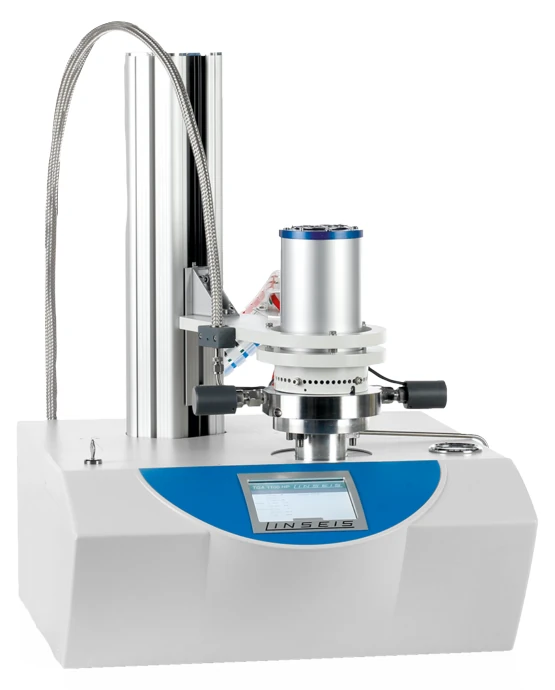
TGA HP L85 High-Pressure Thermogravimetric Analyzer
Référence: LINS-TGA HP L85
https://www.analis.com/shop/lins-tga-hp-l85-tga-hp-l85-high-pressure-thermogravimetric-analyzer-147798 https://www.analis.com/web/image/product.template/147798/image_1920?unique=ad3a0d8The LINSEIS TGA HP L85 is a high-pressure thermogravimetric analyzer (TGA) that combines a high-speed micro furnace with a highly accurate top-loading microbalance. It tests up to 1200 °C and 150 bar in reactive or inert atmospheres, for thermogravimetric studies where pressure governs the reaction.
What does the TGA HP L85 measure?
Thermogravimetric analysis measures the change in sample mass as a function of temperature. The HP L85 does this under pressure (up to 150 bar), which shifts reaction equilibria and reveals behavior invisible at ambient pressure, a key capability for high-pressure gas-solid reactions.
How does it work?
A top-loading microbalance tracks mass change while a high-speed micro furnace heats the sample up to 1200 °C. Plug-and-play TGA sensors are user-exchangeable, and an optional steam generator and various gas-dosing systems adapt the atmosphere to the experiment. Platinum software processes data with minimal parameter input, and AutoEval guides evaluation of standard processes such as glass transitions or melting points.
Key advantages
- High-pressure TGA with top-loading function
- Testing up to 1200 °C and 150 bar in reactive or inert atmospheres
- Plug-and-play TGA sensors that the user can easily exchange
- Tabletop design, optional steam generator and various gas dosing systems for maximum flexibility
- Platinum software with intuitive data processing and minimal parameter input
- AutoEval guidance for evaluating standard processes such as glass transitions or melting points
Application: coal gasification and hydrogasification
A well-known application for high-pressure thermogravimetry. Carbon is heated in an atmosphere of water vapor, a process used in catalytic applications, for example to remove carbon monoxide (CO) from exhaust gases and to recover valuable organic compounds from charcoal or biomass.
- Reaction pathway: at higher temperatures, charcoal or the carbon fraction of biomass reacts with water vapor (C + H₂O → CO + H₂) to form carbon monoxide and hydrogen, with or without extra oxygen. In an oxygen-containing atmosphere, CO also forms via C + O₂ → CO₂, followed by C + CO₂ → 2 CO
- Water-gas shift: carbon monoxide reacts with water to give more hydrogen (CO + H₂O → CO₂ + H₂)
- Pressure effects: these gases take part in chemical equilibria, and the system pressure influences the position of the equilibrium, so measuring under pressure can be decisive
- Methanol and methane: coal gasification aims to produce methanol and methane from CO and hydrogen (CO + 2 H₂ → CH₃OH; CH₃OH + H₂ → CH₄), making carbon a basic building block for almost all organic compounds (pharmaceuticals, polymers, oils, waxes, fatty acids, organic acids, etc.)
Request a demonstration or quote
Ask Analis’ local Benelux experts for more information, a demonstration, or a personalized quote.
Données Techniques
Category | Specification |
Temperature range | RT to 1200°C |
Pressure range | Up to 150 bar |
Sample weight | Up to 5 g |
Resolution | 0.1 µg |
Vacuum | 10E-4 mbar |
TG sensors | Type E/K/S/B/C |
TG-DSC sensors | Type E/K/S/B/C |
Software
The new Platinum software improves your workflow considerably, as the intuitive data processing requires only minimal parameter input. AutoEval provides valuable guidance when evaluating standard processes such as glass transitions or melting points.
Smart product identification tool for thermal libraries: an extensive material database that automatically identifies your tested sample.
Mobile device control and monitoring: manage and monitor your equipment anytime, anywhere via smartphone or tablet.
General Software Features
- Software packages compatible with the latest Windows operating system
- Menu item setup
- All specific measurement parameters (user, laboratory, sample, company, etc.)
- Optional password and user levels
- Undo and redo of all steps
- Unlimited number of heating, cooling or isothermal segments
- Multiple language versions such as English, German, French, Spanish, Chinese, Japanese, etc.
- Evaluation software with a range of functions that enable automated evaluation
- Various smoothing models
- Full evaluation history (all steps can be undone)
- Evaluation and data acquisition can run simultaneously
- Data can be corrected with measurement curve and calibration correction
- Data evaluation includes: peak separation software, signal correction and smoothing, first and second derivative, curve calculation, peak evaluation, glass point evaluation, drift correction
- Zoom/single segment view, overlay of multiple curves, label and drawing tools, copy-to-clipboard function, various export functions for graphics and data, and reference-based correction
Agitateurs et shakers
Agrégation plaquettaire
Analyse cellulaire
Analyse de l'humidité
Analyse thermique
Analyse urinaire
Caractérisation des particules
Centrifugation
Chauffage et refroidissement
Chimie analytique
Chimie clinique
Chromatographie flash & préparative
Contrôle environnemental
Contrôles de qualité cliniques
Couleur-Apparence et tests physiques
Culture cellulaire et fermentation
Cytométrie en flux
Désinfection
Electrophorèse capillaire
Essais et caractérisation des matériaux
Fécondation in vitro (FIV)
Hottes de Protection
Hématologie
Imagerie biologique
Immuno-hématologie
Immunoassay
Lyophilisation
Microbiologie (clinique)
Microscopie
Mobilier de laboratoire et études de conception
Métrologie
Nephelometry (Néphélométrie)
Nettoyage Lavage
POCT
Pesage
Pipetage de liquides (manuel)
Pompes
Préparation d'échantillon
Purification de l'eau
Rhéomètres
Robot de pipetage
Solutions d'automatisation clinique (TLA)
Solutions informatiques cliniques
Spectromètres de masse
Stockage
Stérilisation
Synthèse
Tests sur tablettes
Texturomètres
Toxicologie
Tri cellulaire par Cytométrie en flux
Viscosimètres
Électrochimie