- ADN / ARN (acides nucléiques)
- Agitateurs et shakers
- Agrégation plaquettaire
- Analyse cellulaire
- Analyse de l'humidité
- Analyse thermique
- Analyse urinaire
- Caractérisation des particules
- Centrifugation
- Chauffage et refroidissement
- Chimie analytique
- Chimie clinique
- Chromatographie flash & préparative
- Contrôle environnemental
- Contrôles de qualité cliniques
- Couleur-Apparence et tests physiques
- Culture cellulaire et fermentation
- Cytométrie en flux
- Désinfection
- Electrophorèse capillaire
- Essais et caractérisation des matériaux
- Fécondation in vitro (FIV)
- Hottes de Protection
- Hématologie
- Imagerie biologique
- Immuno-hématologie
- Immunoassay
- Lyophilisation
- Microbiologie (clinique)
- Microscopie
- Mobilier de laboratoire et études de conception
- Métrologie
- Nephelometry (Néphélométrie)
- Nettoyage Lavage
- POCT
- Pesage
- Pipetage de liquides (manuel)
- Pompes
- Préparation d'échantillon
- Purification de l'eau
- Rhéomètres
- Robot de pipetage
- Solutions d'automatisation clinique (TLA)
- Solutions informatiques cliniques
- Spectromètres de masse
- Stockage
- Stérilisation
- Synthèse
- Tests sur tablettes
- Texturomètres
- Toxicologie
- Tri cellulaire par Cytométrie en flux
- Viscosimètres
- Électrochimie
- Analyse thermique Analyse thermogravimétrique (TGA)
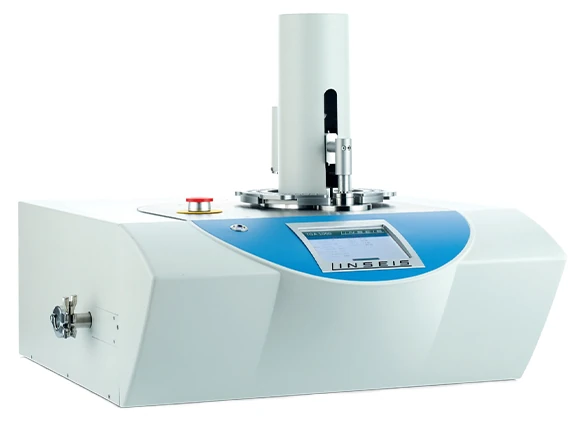
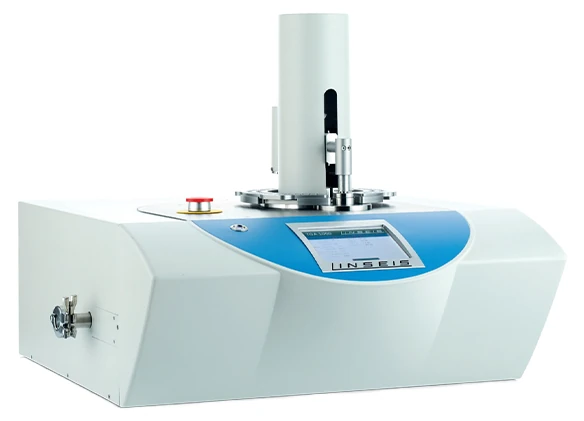
- TGAPT 1000 Thermogravimetric Analyzer
HOME / APPLICATIONS & TECHNIQUES /
TGAPT 1000 Thermogravimetric Analyzer
Référence: LINS-TGA L83
https://www.analis.com/shop/lins-tga-l83-tgapt-1000-thermogravimetric-analyzer-147801 https://www.analis.com/web/image/product.template/147801/image_1920?unique=ad3a0d8The LINSEIS TGA PT 1000 is a thermogravimetric analyzer (TGA) consisting of a digital thermobalance and a sample holder with integrated thermocouple. It analyzes samples of up to 5 g (including the measuring system) from RT (10 °C) to 1100 °C, with a specially developed furnace enabling an exceptionally wide heating and cooling range of 0.001 to 250 °C/min.
What does the TGA PT 1000 measure?
As a thermogravimetric analyzer, the PT 1000 measures the change in sample mass as a function of temperature, for thermal composition analysis, thermal stability tests and oxidation studies. An optional calculated DTA signal adds information on endothermic and exothermic reactions and can be used for temperature calibration.
How does it work?
A digital thermobalance records mass change while the specially developed furnace delivers very precise temperature control across the full range, at rates from 0.001 to 250 °C/min. Measurements run in multiple gas atmospheres, inert, oxidizing, reducing and vacuum, and MS and/or FTIR coupling can be added at any time for evolved-gas analysis.
Key advantages
- Fast heating and cooling from 0.001 to 250 °C/min thanks to a specially developed furnace
- Very precise temperature control across the full range
- Optional calculated DTA signal provides extra information on endothermic and exothermic reactions and can be used for temperature calibration
- MS and/or FTIR coupling possible at any time
- Multiple gas atmospheres: inert, oxidizing, reducing and vacuum
Suitable for
- Thermal composition analysis, thermal stability tests and oxidation studies
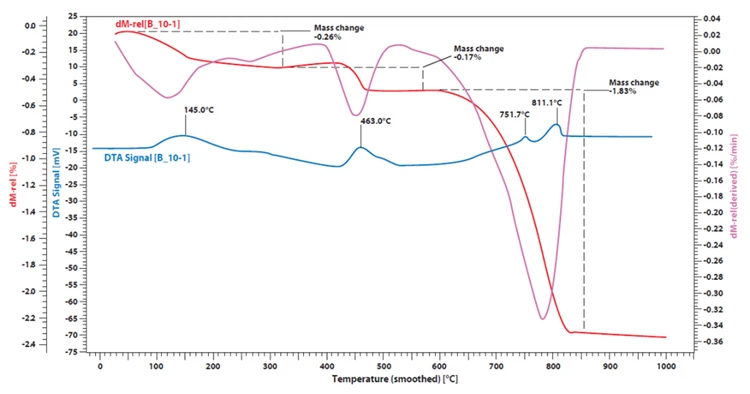
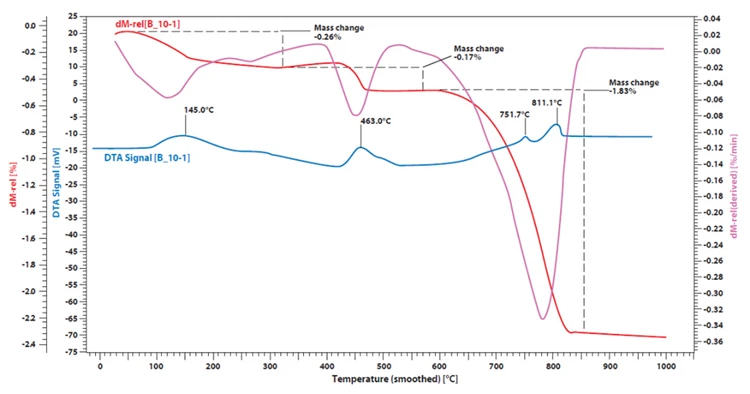
- Cement hydrates: calcium silicate decomposes at 570 °C, followed by the hydroxides of calcium, magnesium and aluminum, then CO₂ splits off from calcium carbonate
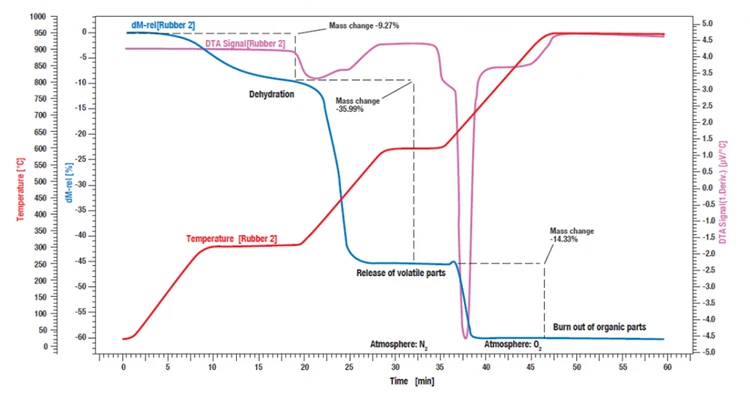
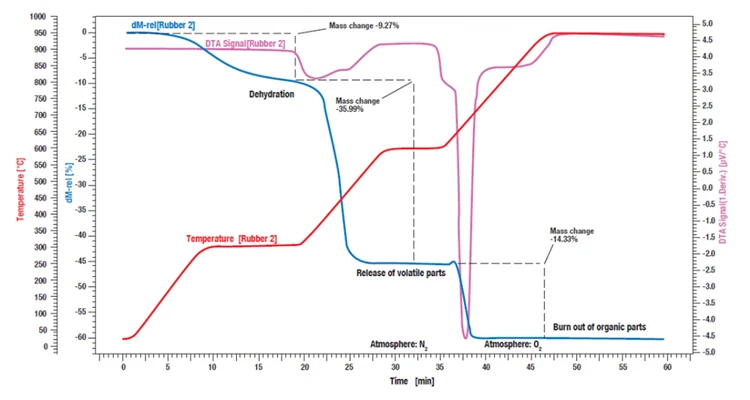
- Rubber degradation: dehydration (9.27% water), pyrolysis of volatile components under N₂ (35.99%), burn-out of organic components in O₂ (14.33%), leaving a 40.41% inorganic residue such as ash, slag or fillers
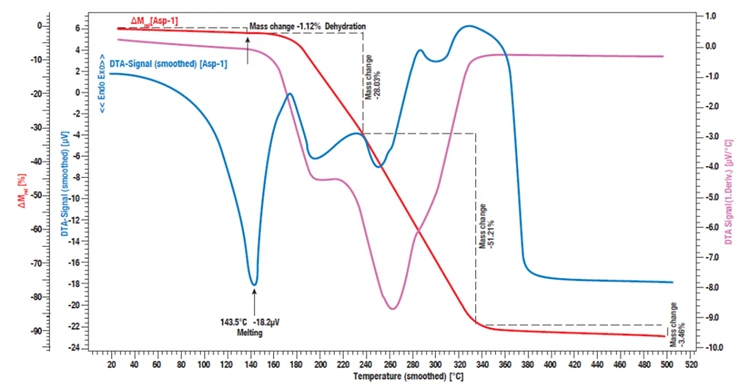
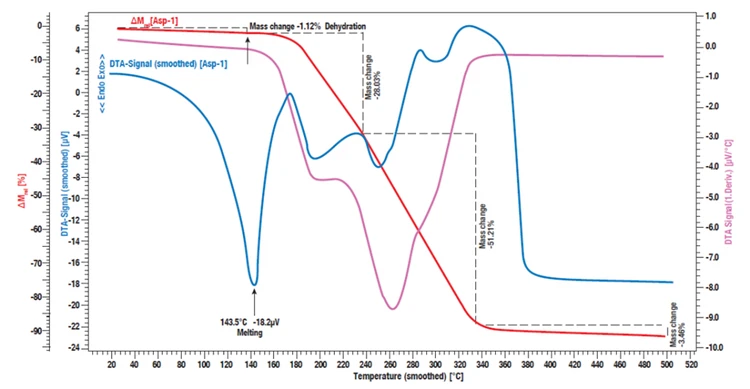
- Aspirin: about 1% weight loss from adsorbed water, melting at 140 °C (exothermic on the DTA trace), decomposition of the molten drug at 160 °C
Request a demonstration or quote
Ask Analis’ local Benelux experts for more information, a demonstration, or a personalized quote.
Données Techniques
Category | Specification |
Temperature range | RT to 1100°C |
Heating and cooling rates | 0.001 to 250°C/min |
Sample weight | max. 5g |
Gas atmospheres | Inert, oxidizing, reducing, vacuum |
Cooling rate | < 12min (1100°C – 100°C) |
Sample holder | TGA |
Software
The powerful LINSEIS thermal analysis software, based on Microsoft® Windows®, plays the key role alongside the hardware in preparing, running and evaluating thermoanalytical experiments. It offers a comprehensive solution for programming all device-specific settings and control functions, and for data storage and evaluation. It was developed by in-house software specialists and application experts and has been proven over many years.
Software features
- Real-time color display
- Automatic and manual scaling
- Freely selectable axis display (e.g. temperature (x-axis) against delta L (y-axis))
- Mathematical calculations (e.g. first and second derivatives)
- Save complete evaluations
- Multitasking function
- Multi-user function
- Zoom option for different curve sections
- Any number of curves can be loaded over each other for comparison
- Online help menu
- Free labeling
- EXCEL® and ASCII export of measurement data
- Data smoothing
- Zero curves are shifted
- Cursor function
- Statistical curve evaluation (mean value curve with confidence interval)
- Tabular printout of data and expansion coefficients
- Calculation of alphaphysics, alphatech, relative expansion L/L0
- Curve arithmetic: add, subtract, multiply
Agitateurs et shakers
Agrégation plaquettaire
Analyse cellulaire
Analyse de l'humidité
Analyse thermique
Analyse urinaire
Caractérisation des particules
Centrifugation
Chauffage et refroidissement
Chimie analytique
Chimie clinique
Chromatographie flash & préparative
Contrôle environnemental
Contrôles de qualité cliniques
Couleur-Apparence et tests physiques
Culture cellulaire et fermentation
Cytométrie en flux
Désinfection
Electrophorèse capillaire
Essais et caractérisation des matériaux
Fécondation in vitro (FIV)
Hottes de Protection
Hématologie
Imagerie biologique
Immuno-hématologie
Immunoassay
Lyophilisation
Microbiologie (clinique)
Microscopie
Mobilier de laboratoire et études de conception
Métrologie
Nephelometry (Néphélométrie)
Nettoyage Lavage
POCT
Pesage
Pipetage de liquides (manuel)
Pompes
Préparation d'échantillon
Purification de l'eau
Rhéomètres
Robot de pipetage
Solutions d'automatisation clinique (TLA)
Solutions informatiques cliniques
Spectromètres de masse
Stockage
Stérilisation
Synthèse
Tests sur tablettes
Texturomètres
Toxicologie
Tri cellulaire par Cytométrie en flux
Viscosimètres
Électrochimie