- ADN / ARN (acides nucléiques)
- Agitateurs et shakers
- Agrégation plaquettaire
- Analyse cellulaire
- Analyse de l'humidité
- Analyse thermique
- Analyse urinaire
- Caractérisation des particules
- Centrifugation
- Chauffage et refroidissement
- Chimie analytique
- Chimie clinique
- Chromatographie flash & préparative
- Contrôle environnemental
- Contrôles de qualité cliniques
- Couleur-Apparence et tests physiques
- Culture cellulaire et fermentation
- Cytométrie en flux
- Désinfection
- Electrophorèse capillaire
- Essais et caractérisation des matériaux
- Fécondation in vitro (FIV)
- Hottes de Protection
- Hématologie
- Imagerie biologique
- Immuno-hématologie
- Immunoassay
- Lyophilisation
- Microbiologie (clinique)
- Microscopie
- Mobilier de laboratoire et études de conception
- Métrologie
- Nephelometry (Néphélométrie)
- Nettoyage Lavage
- POCT
- Pesage
- Pipetage de liquides (manuel)
- Pompes
- Préparation d'échantillon
- Purification de l'eau
- Rhéomètres
- Robot de pipetage
- Solutions d'automatisation clinique (TLA)
- Solutions informatiques cliniques
- Spectromètres de masse
- Stockage
- Stérilisation
- Synthèse
- Tests sur tablettes
- Texturomètres
- Toxicologie
- Tri cellulaire par Cytométrie en flux
- Viscosimètres
- Électrochimie
- Analyse thermique Analyse thermogravimétrique (TGA)
- TGA L87 MSB Magnetic levitation balance ultra-high vacuum
HOME / APPLICATIONS & TECHNIQUES /
TGA L87 MSB Magnetic levitation balance ultra-high vacuum
Référence: LINS-TGA L87 MSB
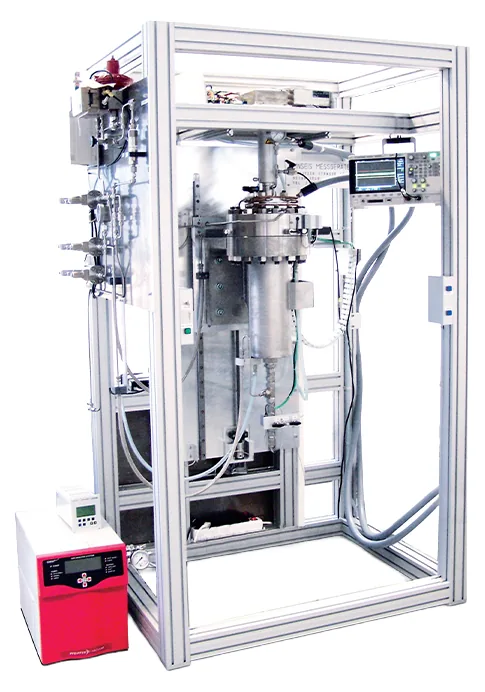
https://www.analis.com/shop/lins-tga-l87-msb-tga-l87-msb-magnetic-levitation-balance-ultra-high-vacuum-147800 https://www.analis.com/web/image/product.template/147800/image_1920?unique=ad3a0d8The LINSEIS MSB PT 1 is a magnetic suspension balance for gravimetric measurements over a wide temperature and pressure range, including in aggressive media. The sample weight is transferred contactlessly to the balance by a levitation coupling, so the sensitive microbalance stays at ambient conditions, protected from high temperatures, high pressures and corrosive atmospheres.
This extends thermogravimetric measurement into temperature and pressure ranges a conventional balance cannot reach.
What does the MSB PT 1 measure?
The MSB PT 1 performs gravimetric (thermogravimetric) measurements under conditions that would destroy a conventional balance. By isolating the microbalance through a magnetic coupling, it measures mass change accurately under extreme temperature, high pressure or aggressive media, and supports evolved gas analysis with MS/FTIR.
How does it work?
Weight is transferred without contact using a levitation magnet (permanent magnet) and a holding magnet (electromagnet attached to the balance). A position sensor and a PID controller keep the levitation position stable, with the electromagnetic force as the control variable. Because the coupling isolates the microbalance, the sample can face extreme conditions while the balance measures safely at ambient.
Metal or glass version?
Two versions cover different environments:
- Metal version: for the widest range of applications, from UHV to 500 bar and −196 °C to 2400 °C, with suitable coatings on the metal measuring cell for corrosive and toxic media
- Glass version: for highly corrosive media, up to 900 °C and 1.3 bar, with sensitive parts such as the levitation magnet and the position-sensor iron core fused in glass
Key advantages
- Contactless weight transfer by a levitation magnet (permanent magnet) and a holding magnet (electromagnet attached to the balance)
- Stable levitation position with a position sensor and a PID controller using the electromagnetic force as control variable
- Extended measuring range for thermogravimetric measurements in a temperature and pressure range not possible with a conventional device
- Metal version: UHV to 500 bar, −196 °C to 2400 °C, with suitable coatings for corrosive and toxic media
- Glass version: for highly corrosive media, up to 900 °C and 1.3 bar
- Gas analysis with MS/FTIR
Suitable for
- Exhaust gas purification, residue incineration and soil decontamination
- Coal gasification, methane synthesis and methane/hydrogen storage
- Supercritical extraction and petrochemical research
- Membrane research (e.g. for fuel cells)
- Food, plastics and polymer production
- Process engineering and chemical research facilities
Request a demonstration or quote
Ask Analis’ local Benelux experts for more information, a demonstration, or a personalized quote.
Données Techniques
Category | Specification |
Temperature range | -196°C to 2400°C |
Pressure range | UHV (ultra high vacuum) up to 150bar |
Sample weight | 10g |
Resolution | 1 µg |
Gas analysis | MS/FTIR |
Metal version | Measurements from UHV to 500 bar in a temperature range of -196°C to 2400°C. Corrosive and toxic media can also be used, made possible by suitable coatings on the metal measuring cell. |
Glass version | Used for measuring highly corrosive media. Sensitive parts in the measuring cell, such as the levitation magnet and the iron core for the position sensor, are fused in glass. The function of the levitation coupling and the automatic decoupling correspond to the metal version. Possible application range is up to 900°C and a pressure of 1.3 bar. |
Magnetic Levitation Balance Design
- A balance for recording the measured values
- A levitation coupling that transfers the weight of the sample to the balance contactlessly
- A sensor for determining the position of the levitation part
- A control unit for controlling the levitation coupling
Software
The powerful Microsoft® Windows®-based LINSEIS thermal analysis software performs the main function, alongside the hardware, in preparing, running and evaluating thermoanalytical experiments. LINSEIS offers a comprehensive solution for programming all device-specific settings and control functions, as well as for data storage and evaluation. The package was developed by LINSEIS in-house software specialists and application experts and has been proven over many years.
Agitateurs et shakers
Agrégation plaquettaire
Analyse cellulaire
Analyse de l'humidité
Analyse thermique
Analyse urinaire
Caractérisation des particules
Centrifugation
Chauffage et refroidissement
Chimie analytique
Chimie clinique
Chromatographie flash & préparative
Contrôle environnemental
Contrôles de qualité cliniques
Couleur-Apparence et tests physiques
Culture cellulaire et fermentation
Cytométrie en flux
Désinfection
Electrophorèse capillaire
Essais et caractérisation des matériaux
Fécondation in vitro (FIV)
Hottes de Protection
Hématologie
Imagerie biologique
Immuno-hématologie
Immunoassay
Lyophilisation
Microbiologie (clinique)
Microscopie
Mobilier de laboratoire et études de conception
Métrologie
Nephelometry (Néphélométrie)
Nettoyage Lavage
POCT
Pesage
Pipetage de liquides (manuel)
Pompes
Préparation d'échantillon
Purification de l'eau
Rhéomètres
Robot de pipetage
Solutions d'automatisation clinique (TLA)
Solutions informatiques cliniques
Spectromètres de masse
Stockage
Stérilisation
Synthèse
Tests sur tablettes
Texturomètres
Toxicologie
Tri cellulaire par Cytométrie en flux
Viscosimètres
Électrochimie