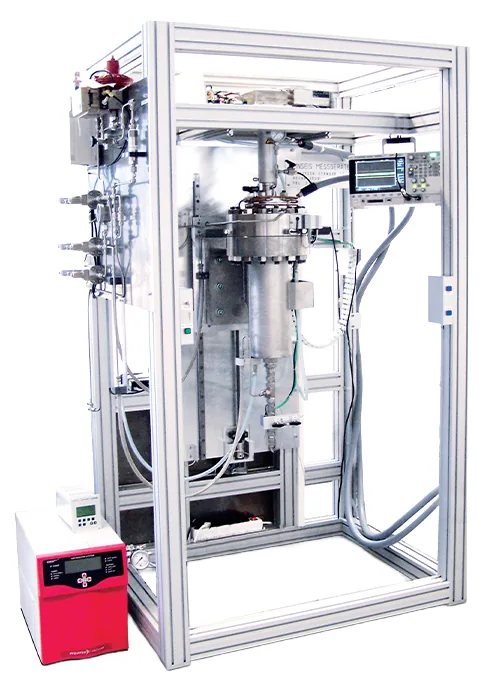
STA MSB PT 1 Magnetic Suspension Balance
Referentie: LINS-STA L87
https://www.analis.com/shop/lins-sta-l87-sta-msb-pt-1-magnetic-suspension-balance-147795 https://www.analis.com/web/image/product.template/147795/image_1920?unique=ad3a0d8The LINSEIS MSB PT 1 is a magnetic suspension balance for gravimetric measurements over a wide temperature and pressure range, including under aggressive media. It consists of a balance that records the measured values, a suspension coupling that carries the sample weight, a position sensor for the levitation part and a control unit that drives the coupling.
The key principle is contactless weight transfer: the sample hangs from a magnetic coupling, so the sensitive microbalance stays at ambient conditions and is protected from heat, pressure and corrosive atmospheres.
What does the MSB PT 1 measure?
The MSB PT 1 performs gravimetric and density measurements under conditions that would damage a conventional balance. Density is determined using the principle of Archimedes: a mass of known volume is weighed and the density is calculated from the buoyancy of the sample. The compact construction allows this over a large temperature and pressure range, and evolved gas analysis with MS/FTIR is possible.
How does it work?
Weight is transferred without contact using a levitation magnet (permanent magnet) and a holding magnet (electromagnet suspended from the balance). A position sensor and a PID controller keep the levitation position stable, with the electromagnetic force as control variable. Because the magnetic coupling isolates the microbalance, the sample can be exposed to extreme temperature, high pressure or aggressive media while the balance measures safely at ambient conditions.
Key advantages
- Contactless weight transfer using a levitation magnet (permanent magnet) and a holding magnet (electromagnet hanging from the balance)
- Stable levitation position from a position sensor and a PID controller, with the electromagnetic force as control variable
- Balance protected from high temperatures, pressure and aggressive media, because the magnetic coupling allows the microbalance to be set up at ambient conditions
- Density analysis using the principle of Archimedes: a mass of known volume is weighed and the density is calculated from the buoyancy of the sample
- Compact construction that allows density analysis over a large temperature and pressure range
- Evolved gas analysis with MS/FTIR possible
Suitable for
- Plastics production
- Exhaust gas purification
- Food production
- Supercritical fluid extraction
- Coal gasification
- Soil decontamination
- Purification and storage of natural gas and hydrogen
- Analysis of fuel cell membranes
- Waste incineration
- Process and chemical technology research
Request a demonstration or quote
Ask Analis’ local Benelux experts for more information, a demonstration, or a personalized quote.
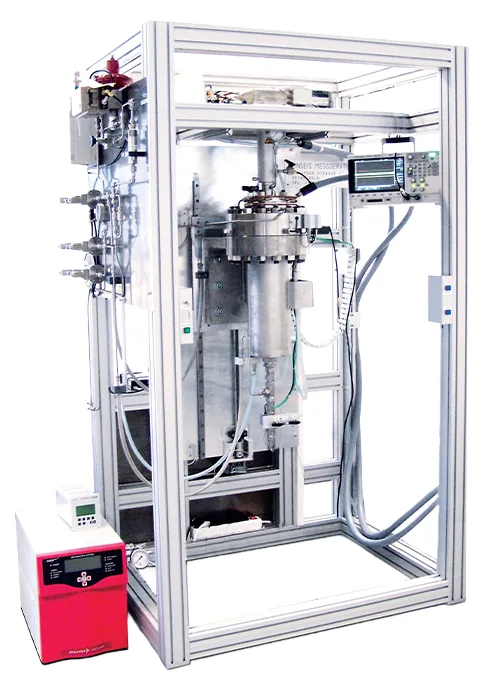
Technische Informatie
Category | Specification |
Model | Metal version |
Temperature range | -196 to 2400 °C |
Pressure range | UHV (ultra-high vacuum) to 150 bar |
Vacuum | 10E-4 mbar |
Sample weight | 10 g (standard balance) |
Resolution | 1 µg |
Evolved gas analysis | MS/FTIR possible |
Software
All LINSEIS thermal analysis instruments are PC-controlled. The individual software modules run exclusively under Microsoft® Windows® operating systems. The complete software consists of 3 modules: temperature control, data acquisition and data evaluation. The 32-bit software contains all essential functions for preparing, running and evaluating an STA measurement. Together with its specialists and application experts, LINSEIS developed comprehensive, easy-to-understand and user-friendly application software.
General software features
- Text-editing program
- Data protection on power failure
- Thermocouple break protection
- Repeat measurements with minimal parameter input
- Evaluation of ongoing measurement
- Curve comparison of up to 32 curves
- Storage and export of evaluations
- ASCII data export and import
- Data export to MS Excel
- Analysis with multiple methods (DSC, TG, TMA, DIL, etc.)
- Zoom function
- 1st and 2nd derivative
- Programmable gas control
- Statistical evaluation package
- Free scaling