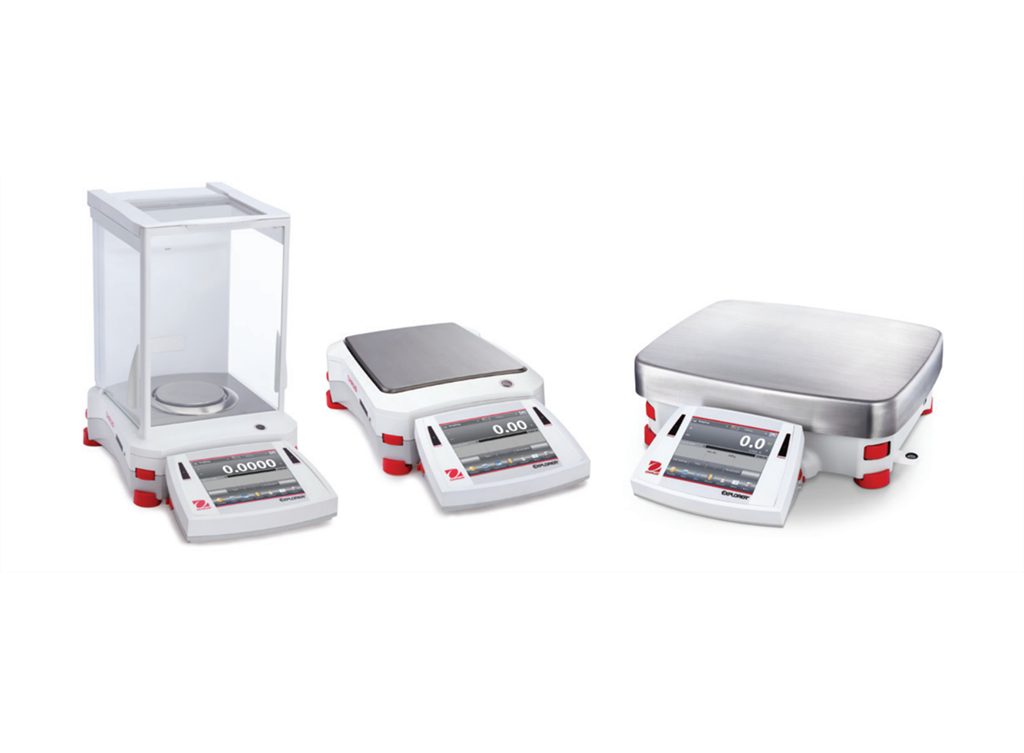
What is a laboratory balance?
The key performance parameters of a laboratory balance include maximum capacity, readability, repeatability, linearity, and stabilization time. Together, these parameters determine the balance’s measurement range, accuracy, precision, and response speed. Depending on your laboratory’s specific requirements, different types of laboratory balances are available, including ultra-microbalances, microbalances, semi-microbalances, analytical balances, and precision balances.
New OHAUS Explorer Series: The Future of Laboratory Weighing
Crafted from legacy and designed for innovation, this new Explorer serie redefines performance for every laboratory, with enhanced security and intuitive operation.
Experience a new standard of lab technology with features like:
- Enhanced Security: Protect your valuable data and samples.
- Intuitive Navigation: A user-friendly interface for effortless operation.
- Effortless Levelling: The balance adjusts automatically for maximum accuracy.
- Precise Environmental Adaptation: Ensures stability and accuracy in any lab condition.
- Digital High-Speed Weighing Cell: Delivers fast, accurate results every time.
The new Explorer Series consist of two ranges: EXR and EXP.
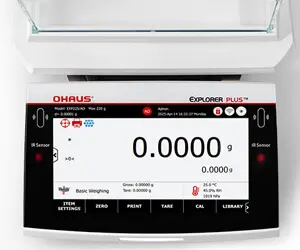
What is a semi-micro balance?
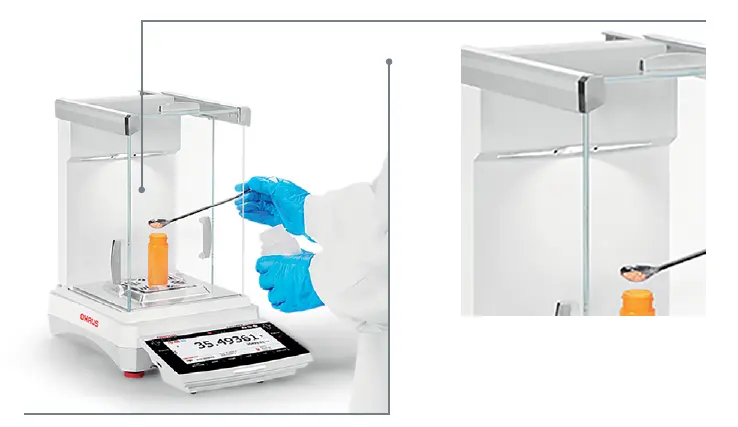
A semi-micro balance is a balance with a readability of 0,01 mg. It is often used to measure very low quantities of sample with a demand for a very good repeatability. This type of balance always has a draft shield and readability of 0,01 mg. The weighing platform is round with a diameter around 80 mm. The capacity (max weight) of semi-micro balances varies between 50 and 120 g. Sometimes they also have a built-in ionizer to eliminate the effect of electrostatic charges.
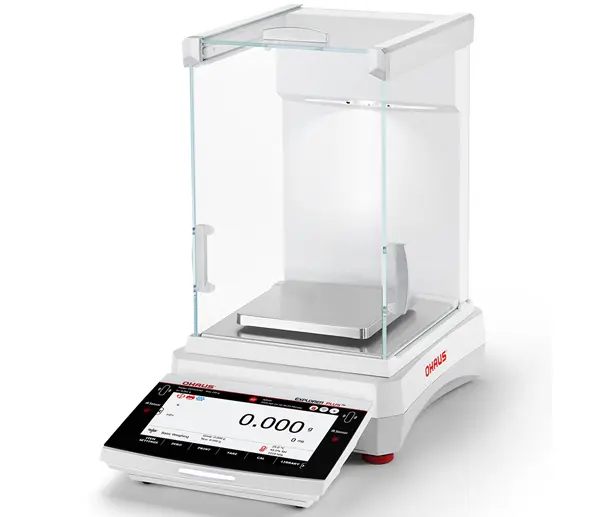
What is an analytical balance?
An analytical balance is a balance with a readability of 0,1 mg. This type of balance always has a draft shield. The weighing platform is typically round with a diameter around 90 mm. The capacity varies between 100 and 350 g.
What is a precision balance?
A precision balance is a balance with a readability of 0,001; 0,01 or 0,1 g. The balances of 0,001 g often come with a draft shield. The balances of 0,01 and 0,1 g come without draft shield. The weighing platform can be round or rectangular. The capacity of precision balances varies between 220g and 35 kg.
How do laboratory balances work?
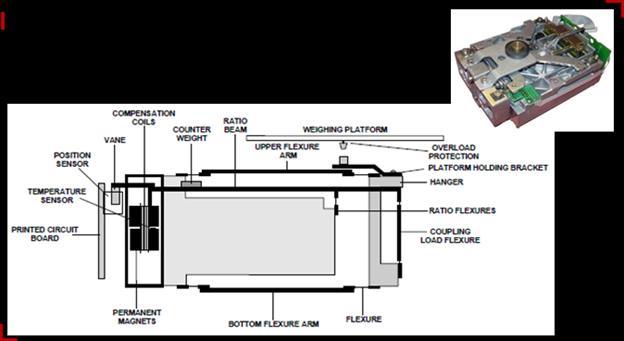
Most laboratory balances use a weighing cell with electromagnetic compensation. For this type of load cell, a leverage is used. One side of the leverage is connected to the weighing platform. The other side is connected to a coil. The coil is positioned around a magnet and is itself electromagnetic. The electromagnetic force of the coil depends on the amount of power that is sent through it. When there’s a sample on the weighing platform, the leverage will move the coil upwards. The balance will try to move the coil back to the same position by increasing the power sent through the coil. This will increase the electromagnetic force. The amount of power needed to move the coil back to its original position is directly related to the mass of the sample. The controller of the balance will use the needed power to calculate and display the mass of the sample.
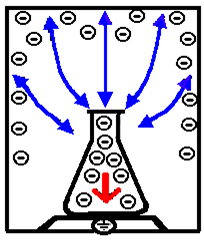
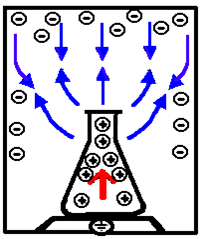
What is an ioniser?
Electrostatic charges, or static electricity, are caused by friction on objects with a low conductivity and a high surface. Typical examples are plastic and glass weighing boats. The draft shield of the balance is often constructed of glass and plastics and has a negative charge. When the sample or weighing boat has an electrical charge, there will be a repulsion or attraction due to the load on the draft shield. This interaction will create an upward or downward force that can affect the weighing results.
Built-in ioniser in the NEW OHAUS EXPLORER Plus EXP Balances
Superior Measurement Stability: A built-in ioniser in the draft shield removes the static charge from the sample surface and neutralises the weighing chamber, creating a stable environment.
Explorer Plus EXP: Ioniser has been integrated into the draft shield that:
- Actively removes electrostatic charge from the surface of samples
- Neutralises the weighing chamber, creating a stable environment
- Ensures more consistent and repeatable results
- Eliminates the need for external ionisers
What is a moisture balance?
A moisture balance or moisture analyzer is an instrument to measure the moisture content or dry content of a sample. The principle used is thermogravimetry. The technology uses a precision balance and a heating element. The heating element (halogen lamp or metal infrared heater) dries the sample. The precision balance weighs the sample during the drying process. If there is no or little moisture loss detected, the moisture balance can calculate the moisture content or dry content based on the weight difference. The main advantage of this technology is its speed: you can determine the moisture content of a sample in a few minutes, while classical methods with a drying oven usually take hours or even days.
Elevate Your Moisture Analysis with the next generation of OHAUS MB Series Moisture Analyzers. Featuring a sleek design and incorporating an upgraded loadcell and carbon fiber heating technology for improved durability, stability and performance for reliable results in lab applications and production floors. Whether you need routine moisture testing (MB32), application versatility (MB62), or high-performance precision (MB92), the MB Series has you covered.
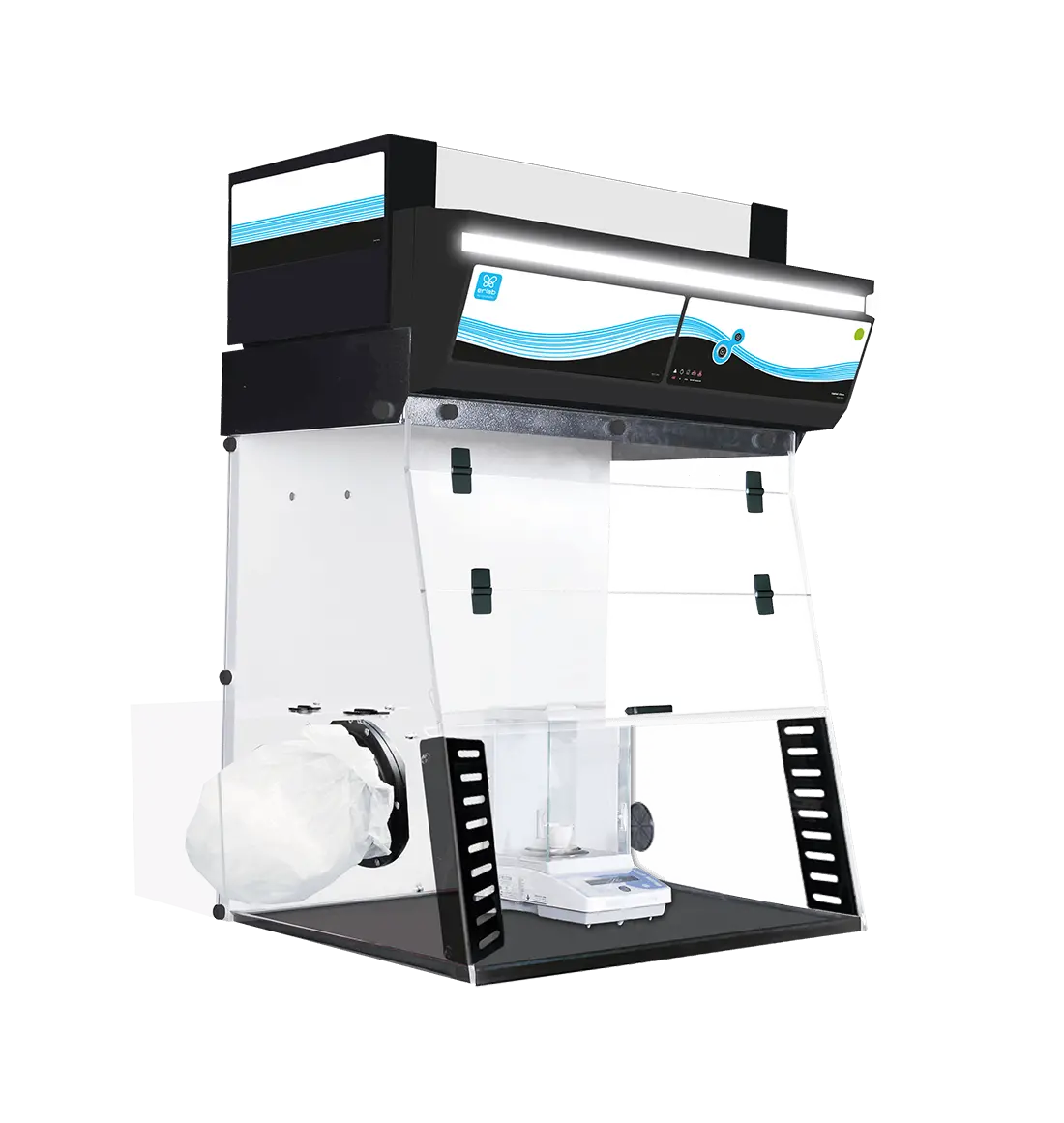
What is a powder weighing cabinet?
Designed to guarantee the highest level of safety.
ERLAB's secure weighing station guarantees an outstanding level of safety for users. It provides the required stability as well as the level of accuracy (up to 10-6 g) required when weighing in the laboratory.
A powder weighing cabinet (or balance enclosure) is a specialized ventilated workstation designed to protect laboratory personnel from inhaling hazardous chemical powders and particulates during precision weighing, mixing, or dispensing It is the ideal solution for hazardous operations which require a confined environment, eliminating any risk of personnel being exposed to toxic products.