Cancer is one of the biggest challenges we face.
13 Million
people will die from cancer in 2035 (Global Cancer Observatory),
40% of people
will get cancer in their lifetimes (ACS). The global cost of cancer for the society reaches USD
1,2 Trillion dollars
(WH0).
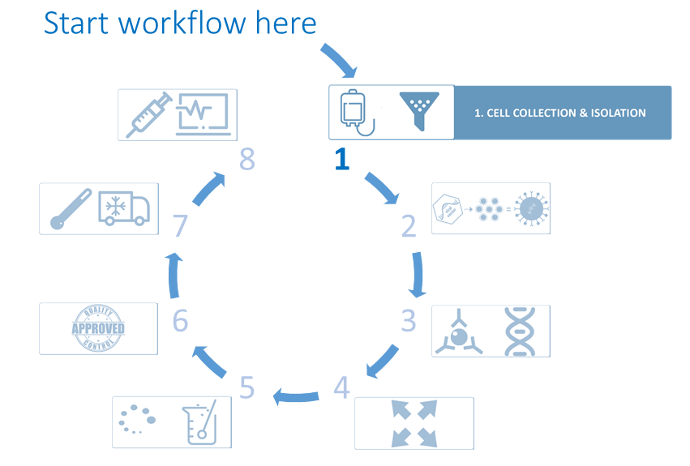
The development of immunology-based biopharmaceutical products has grown sharply in recent years, with clear contributions to human health. The workflow shown here and on the related pages details the needs of the development and production processes for CAR-T cells (*1).
Immunotherapeutic approaches
Antibodies are the leading modality in immunotherapy, while chimeric antigen receptor (CAR) T-cell therapies mark a newer strategy. Many approaches exist: cell-based strategies such as adoptive cell transfer, receptor-pathway strategies such as checkpoint inhibition, and agent-based approaches such as antibody therapy.
Genetic engineering can be built into all these approaches. Gene editing can modulate receptor expression, induce production of certain molecules, change cell phenotypes, or adjust the overall intensity of the immune response.
Cell therapies keep evolving and improving, giving cancer patients new options. They are being evaluated in clinical trials — alone and in combination — across many cancer types. Adoptive cell therapy (ACT), also called cellular immunotherapy, uses the body's own immune cells to fight cancer. Some approaches simply isolate and expand the patient's immune cells; others genetically engineer them (via gene therapy) to boost their cancer-fighting ability.
The cells can come from two sources, depending on the process. In autologous transplants, they come from the person who will receive them, so the patient is their own donor. In allogeneic transplants, the cells come from another person — a related or unrelated donor.
Our immune system can recognize and eliminate cells that have become infected or damaged, as well as those that have become cancerous.








Introduction & overview of immunotherapy
An overview of the basics of immunotherapy and the agents and techniques commonly used.
Is Immunotherapy Living up to its Promise?
Watch this webinar on the progress and performance of immunotherapy, presented by Jill O'Donnell-Tormey and Alex Y. Huang.
In cancer, immune cells called killer T cells are especially effective because they bind to markers (antigens) on the surface of cancer cells. Cellular immunotherapies harness this natural ability and can be deployed in several ways:
Tumor-Infiltrating Lymphocyte (TIL) Therapy, Engineered T Cell Receptor (TCR) Therapy, Chimeric Antigen Receptor (CAR) T Cell Therapy, Natural Killer (NK) Cell Therapy.
By combining synthetic biology tools such as CARs and CRISPR/Cas9 (*4), we have an unprecedented opportunity to program T cells optimally and improve adoptive immunotherapy for most — if not all — future patients.
Somatic mutations acquired by cancer cells can be recognized as 'non-self' by the immune system and can trigger an immune response that selectively targets and removes tumor cells. Displaying these peptides to the immune system takes several steps, each with optimal conditions. So even in cancers with a high mutation burden and many potential neoantigens (*5), only a fraction ultimately mount an immune response. With recent advances in molecular and in silico methods, the number of identified immunogenic neoantigens has risen substantially — and more verified neoantigens improve the ability of trained in silico tools to reliably identify those with clinical utility.
Analis provides strong expertise to support the development of cancer immunotherapies, including adoptive cell therapies (ACT), CAR T-cell therapies (*1), immune checkpoint inhibitors (*2), gene therapies (*3) and vaccines. We aim to advance the next generation of cell therapies by exploring how to robustly validate assays and improve the characterization of cell-immunotherapy analytics, ensuring safe, effective, high-quality products.
CAR-T cell therapy: Introduction & overview
Video introducing CAR-T cell therapy as part of immunotherapy.
Recent Advances in Immunotherapy: Directing Cells to Address Disease
Watch this webinar by Leena Gandhi, MD, PhD, on recent advances in immunotherapy, focusing on directing cells to address disease.
Definitions
(*1) Chimeric Antigen Receptor T cells (CAR-T cells)
Adoptive cell therapy with chimeric antigen receptor T cells (CAR-T cells) is a promising cancer immunotherapy strategy that has developed rapidly. CAR-T cells are T cells (from the patient or a donor) genetically modified to express a chimeric antigen that specifically recognizes tumor-specific antigens on tumor cell surfaces and then kills the tumor cells. In Europe, CAR-T therapies are classed as advanced therapy medicinal products (
ATMPs), and more specifically gene therapy medicinal products (
GTMPs).
(*2) Immune Checkpoint Inhibitors
Immune checkpoint inhibitors work by releasing a natural brake on the immune system so that T cells recognize and attack tumors.
This therapy is sometimes called immune checkpoint blockade, because the drug blocks the molecule that acts as a brake on immune cells — the checkpoint. That prevents the 'off' signal, letting T cells kill cancer cells.
(*3) Gene Therapy
Human gene therapy aims to modify the expression of a gene or alter the biological properties of living cells for therapeutic use. It is a technique that modifies a person's genes to treat or cure disease.
Gene therapies can work by several mechanisms:
- Replacing a disease-causing gene with a healthy copy
- Inactivating a disease-causing gene that is not functioning properly
- Introducing a new or modified gene into the body to help treat a disease
- Using RNA interference or mRNA technology to regulate gene expression
Gene therapy products are being studied to treat diseases such as cancer, genetic diseases and infectious diseases. There are several types, including:
- Plasmid DNA: circular DNA molecules can be engineered to carry therapeutic genes into human cells.
- Viral vectors: viruses naturally deliver genetic material into cells, so some gene therapy products are derived from viruses. Once modified to remove their ability to cause disease, these viruses can serve as vectors to carry therapeutic genes into human cells.
- Bacterial vectors: bacteria can be modified so they no longer cause disease, then used as vectors to carry therapeutic genes into human tissues.
- Human gene editing technology: gene editing aims to disable harmful genes or repair mutated genes.
- RNA-based therapies: these use RNA, including mRNA, to regulate gene expression or encode therapeutic proteins.
- Patient-derived cellular gene therapy products: cells are taken from the patient, genetically modified (often using a viral vector) and then returned to the patient.
(*4) Clustered regulatory interspaced short palindromic repeat/CRISPR-associated protein 9 (CRISPR/Cas9)
CRISPR/Cas9 technology holds great promise thanks to its flexibility, simplicity, high efficiency and multiplexing in precise genome editing. CRISPR systems cleave double-stranded DNA, triggering a host repair mechanism that can inactivate a gene by introducing insertion/deletion mutations at the cut site. Crucially, this cleavage can be directed with guide RNAs, letting scientists inactivate specific genes of interest.
Despite the success of CAR-T therapies, some patients cannot receive them due to insufficient T-cell numbers or rapid disease progression. In some cases, poor response is due to intrinsic autologous T-cell defects or the cells' inability to function well in a strongly immunosuppressive tumor microenvironment. Recent work using CRISPR/Cas9 aims to overcome these limits, enhancing potency and increasing the availability of CAR-based therapies. Combining synthetic biology tools such as CARs and CRISPR/Cas9 offers an unprecedented opportunity to program T cells optimally and improve adoptive immunotherapy for most — if not all — future patients.
For more on how CRISPR can be used in immunotherapy, watch the short video in Step 2. Vector Design & Production.
(*5) Neoantigen
A neoantigen is a new protein that forms on cancer cells when certain mutations occur in tumor DNA. It can play an important role in helping the body mount an immune response against cancer cells.
Sources :
- Waldman, A.D., Fritz, J.M. & Lenardo, M.J. (2020). A guide to cancer immunotherapy: from T cell basic science to clinical practice. Nat Rev Immunol 20, 651–668 (2020). https://doi.org/10.1038/s41577-020-0306-5
- Salas-Mckee, J., Kong, W., Gladney, W. L., Jadlowsky, J. K., Plesa, G., Davis, M. M., & Fraietta, J. A. (2019). CRISPR/Cas9-based genome editing in the era of CAR T cell immunotherapy. Human vaccines & immunotherapeutics, 15(5), 1126–1132. https://doi.org/10.1080/21645515.2019.1571893
- Hutchison, S., & Pritchard, A. L. (2018). Identifying neoantigens for use in immunotherapy. Mammalian genome : official journal of the International Mammalian Genome Society, 29(11-12), 714–730. https://doi.org/10.1007/s00335-018-9771-6
- Immunotherapy Research and Information - Beckman Coulter