- Analytical chemistry
- Automated Liquid Handling
- Capillary Electrophoresis
- Cell culture and Fermentation
- Cell health
- Centrifugation
- Chromatography (flash & prep)
- Cleaning
- Clinical Automation (TLA)
- Clinical IT solutions
- Clinical chemistry
- Clinical quality controls
- Color-Appearance and Physical tests
- DNA / RNA (Nucleic acids)
- Disinfection
- Electrochemistry
- Environmental monitoring
- Flow cytometry
- Flow cytometry Cell sorting
- Freeze drying
- Heating & cooling
- Hematology
- Imaging
- Immuno-Hematology
- Immunoassay
- In Vitro Fertilization (IVF)
- Lab furniture & design studies
- Liquid Handling (Manual)
- Mass spectrometers
- Material testing & characterization
- Metrology
- Microbiology (Clinical)
- Microscopy
- Moisture analysis
- Nephelometry
- POCT
- Particle characterization
- Platelet aggregation
- Protection cabinets
- Pumping
- Rheometers
- Sample preparation
- Shakers and stirrers
- Sterilization
- Storage
- Synthesis
- Tablet testing
- Texture analyzers
- Thermal analysis
- Toxicology
- Urine analysis
- Viscometers
- Water purification
- Weighing
- Thermal analysis Dilatometry
- DIL L74 Optical Dilatometer
HOME / APPLICATIONS & TECHNIQUES /
DIL L74 Optical Dilatometer
Reference: LINS-DIL L74 OD
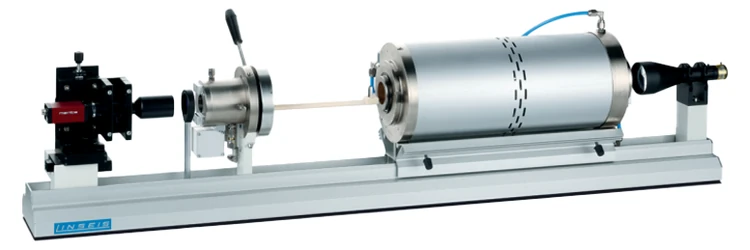
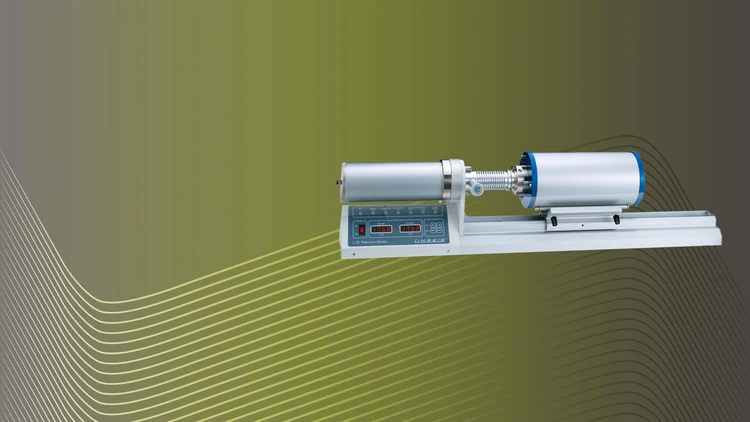
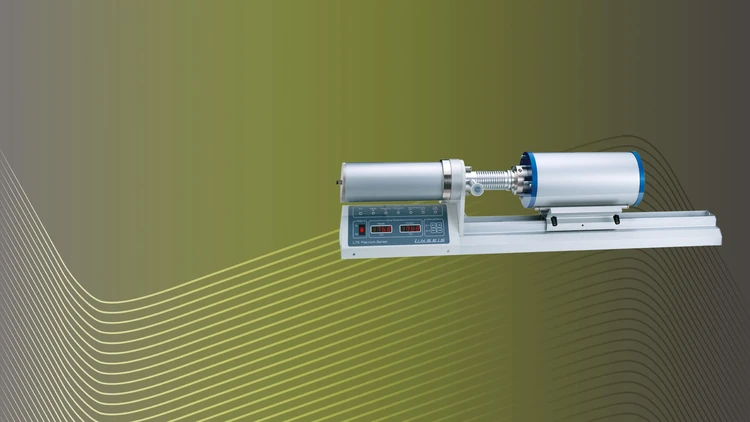
https://www.analis.com/shop/lins-dil-l74-od-dil-l74-optical-dilatometer-147777 https://www.analis.com/web/image/product.template/147777/image_1920?unique=ad3a0d8The LINSEIS DIL L74 OD is an optical dilatometer built for the demanding applications of the glass, ceramics, metal and energy industries. A high-resolution CCD camera enables visual, real-time analysis of sample expansion, as single frames or video sequences.
The measurement is contact-free: no force is applied to the sample, so results on soft samples, or samples that melt during the measurement, are not distorted by contact pressure.
What does the DIL L74 OD measure?
A dilatometer measures the dimensional change (expansion and shrinkage) of a material as a function of temperature. The optical design of the L74 OD does this without any mechanical contact, tracking the sample visually with the CCD camera. A solid-liquid adapter extends this to expansion and volume measurements of solids, liquids and solid-liquid phase transitions.
Why contact-free (optical) dilatometry?
Classic push-rod dilatometers apply force through a rod, which distorts results on soft or melting samples. The L74 OD applies no force at all, so it measures materials a push-rod instrument cannot handle reliably, including rigid foils (with special sample holders) and samples that soften or melt during heating. This makes it well suited to glass, ceramics, metals and energy-sector materials.
Key advantages
- Contact-free measurement with no force on the sample, so the result is not distorted by contact pressure
- High-resolution CCD camera for real-time visual analysis as single frames or video sequences
- Horizontal design for the most demanding applications
- Solid-liquid adapter for expansion and volume measurements of solids, liquids and solid-liquid phase transitions
- Special sample holders for rigid foils, avoiding the push-rod force errors of a classic dilatometer
- LINSEIS Evaluation software with various correction and analysis functions, including comparison of up to 32 curves
- Data protection in case of power failure and protection against thermocouple breakage
Suitable for
- Glass industry
- Ceramics industry
- Metal industry
- Energy industry
- Soft samples and samples that melt during measurement
Request a demonstration or quote
Download the brochure below for full specifications. Ask Analis’ local Benelux experts for more information, a demonstration, or a personalized quote.
Technical information
Category | Specification |
Field of view | 3.3 x 2.8 mm |
Atmosphere | Oxidizing (optional: reducing, inert and vacuum) |
Vacuum | Up to 10E-5mbar |
Heating rate | 0.01 to 100°C/min (depending on furnace) |
International standards | ASTM D1857, CEN/TR 15404, BS 1016: Part 15, CEN/TS 15370-1, DIN 51730, IS 12891, ISO 540, NF M03-048 |
Interface | USB |
Measuring Principle
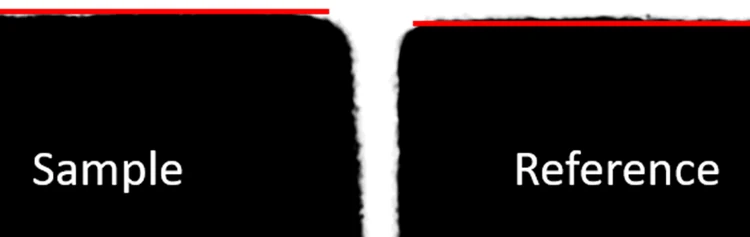
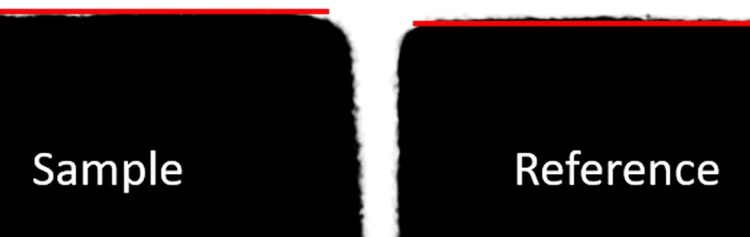
In an optical dilatometer, the sample is compared with a reference during the measurement. The result is the difference between the two lines. The field of view covers 3.3 x 2.8 mm.
Accessories and/or Software
All LINSEIS thermal analysis instruments are PC-controlled. The individual software modules run exclusively under Microsoft® Windows® operating systems. The complete software consists of 3 modules: temperature control, data acquisition and data evaluation. The 32-bit software contains all essential functions for preparing, running and evaluating a dilatometer measurement. LINSEIS specialists and application experts developed comprehensive, easy-to-understand, user-friendly application software.
Software Features
- Text editing program
- Data protection in case of power failure
- Protection against thermocouple breakage
- Repeat measurements with minimal parameter input
- Evaluation of current measurement
- Curve comparison of up to 32 curves
- Storage and export of evaluations
- ASCII data export and import
- Data export to MS Excel
- Multi-method analysis (DSC TG, TMA, DIL, etc.)
- Zoom function
- 1st and 2nd derivative
- Programmable gas control
- Statistical evaluation package
- Free scaling
Automated Liquid Handling
Capillary Electrophoresis
Cell culture and Fermentation
Cell health
Centrifugation
Chromatography (flash & prep)
Cleaning
Clinical Automation (TLA)
Clinical IT solutions
Clinical chemistry
Clinical quality controls
Color-Appearance and Physical tests
DNA / RNA (Nucleic acids)
Disinfection
Electrochemistry
Environmental monitoring
Flow cytometry
Flow cytometry Cell sorting
Freeze drying
Heating & cooling
Hematology
Imaging
Immuno-Hematology
Immunoassay
In Vitro Fertilization (IVF)
Lab furniture & design studies
Liquid Handling (Manual)
Mass spectrometers
Material testing & characterization
Metrology
Microbiology (Clinical)
Microscopy
Moisture analysis
Nephelometry
POCT
Particle characterization
Platelet aggregation
Protection cabinets
Pumping
Rheometers
Sample preparation
Shakers and stirrers
Sterilization
Storage
Synthesis
Tablet testing
Texture analyzers
Thermal analysis
Toxicology
Urine analysis
Viscometers
Water purification
Weighing