DIL L75 PT Vertical
Reference: LINS-DIL L75vertical
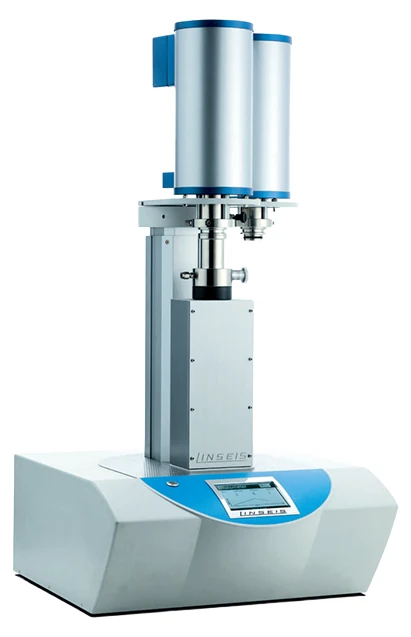
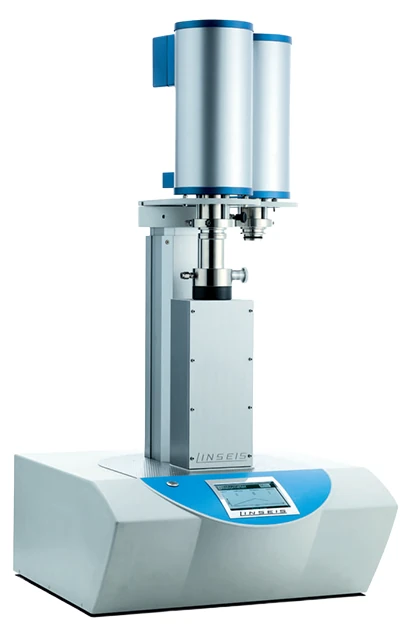
https://www.analis.com/shop/lins-dil-l75vertical-dil-l75-pt-vertical-147779 https://www.analis.com/web/image/product.template/147779/image_1920?unique=ad3a0d8The LINSEIS DIL L75 V is a vertical pushrod dilatometer developed for academic and research laboratories. It determines the thermal expansion behavior of solids, liquids, powders and pastes across a wide range of applications.
Its vertical “Zero-Friction” design suits materials with low and ultra-low expansion, and measurements run under vacuum, oxidizing and reducing atmospheres, including operation under H₂.
What does the DIL L75 V measure?
In a single run, the L75 V determines many properties, including CTE (coefficient of thermal expansion), linear thermal expansion, alpha physical, sintering temperature, phase transformations, softening points, decomposition temperatures and glass transition temperatures. This makes it a versatile tool for ceramics, glass, metals and research materials.
How does it work?
The vertical Zero-Friction pushrod design minimizes friction-induced error, which is essential for low- and ultra-low-expansion materials. Measurements run under vacuum, oxidizing or reducing atmospheres (and under H₂), and the instrument is available in single or differential versions, for higher accuracy or higher sample throughput. A multi-furnace configuration (up to 3 motorized furnaces) and a glovebox option add flexibility, while the Cryo option extends the range down to 10 K with the LINSEIS L75 Cryo “Ultra Low Temperature” series (−263 °C to +220 °C).
Key advantages
- Vertical Zero-Friction design for low and ultra-low expansion materials
- Flexible atmospheres with measurements under vacuum, oxidizing and reducing atmospheres, and the ability to operate under H₂
- Single or differential version for even higher accuracy or sample throughput
- Glovebox option with the mechanical and electronic components separable to allow measurements in a glovebox
- Cryo option down to 10 K with the LINSEIS L75 Cryo “Ultra Low Temperature” series in vertical mode (−263 °C to +220 °C)
- Many properties from one run including CTE, linear thermal expansion, alpha physical, sintering temperature, phase transformations, softening points, decomposition temperatures and glass transition temperatures
- Multi-furnace configuration with up to 3 furnaces and motorized furnace operation
Suitable for
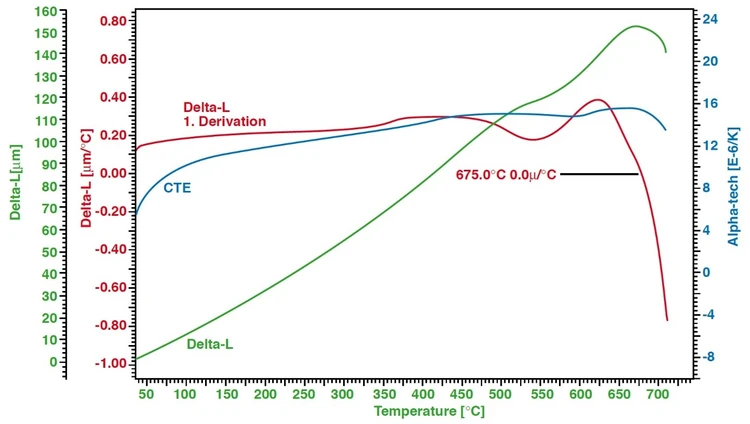
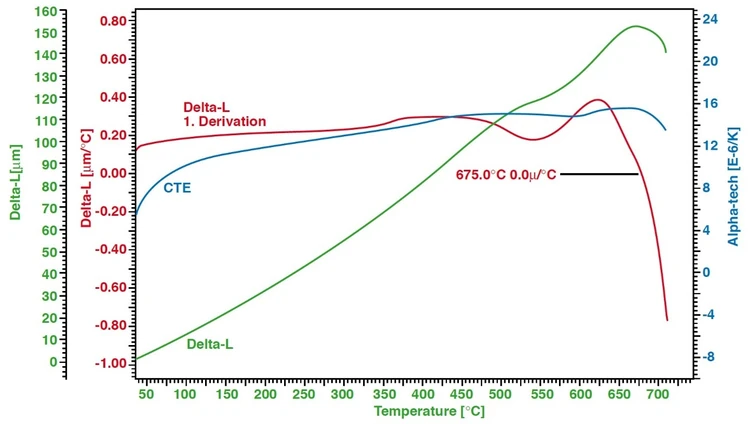
- Glass ceramics: determination of thermal expansion (CTE) and softening point; the first derivative of the absolute expansion shows the maximum of the thermal expansion, and so the softening point
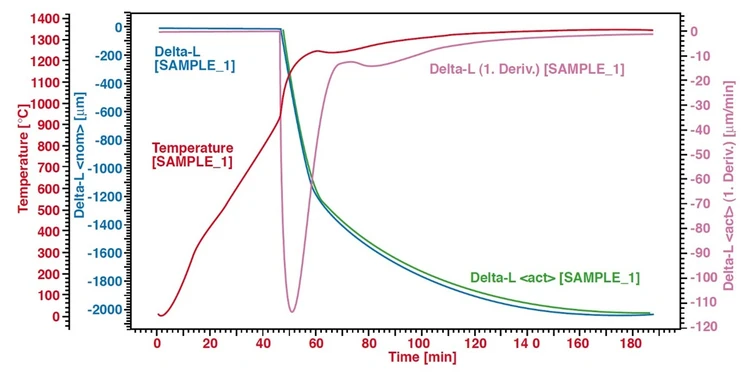
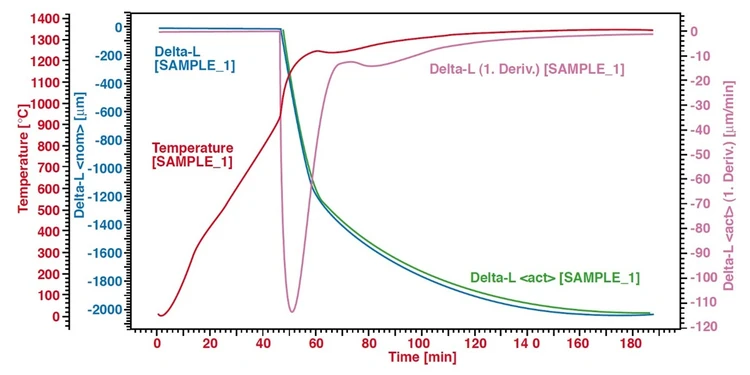
- Sintering of high-tech ceramics: simulation of sintering processes, with the optional Rate Controlled Sintering (RCS) software based on the PALMOUR III theory
- ZrO₂ sintering: example reaching a final density of 100%, with the initial heating rate decreasing as the final density is approached
Request a demonstration or quote
Download the brochure below for full specifications. Ask Analis’ local Benelux experts for more information, a demonstration, or a personalized quote.
Technical information
Category | Specification |
Temperature range | -263 °C to 2800 °C |
Delta L resolution | 0.03 nm |
Measuring range | ± 2500 µm |
Contact force | 10 mN to 1 N |
Delta L resolution | 0.1 nm |
Measuring range | ± 25000 µm |
Automatic sample length detection | Yes |
Force modulation | Yes |
Contact force | 10 mN to 5 N |
Multi-furnace configuration | Up to 3 furnaces |
Motorized furnace operation | Included |
Gas dosing | Manual gas dosing or mass flow controller for 1/3 or more gases |
Contact force adjustment | Included |
Single/dual dilatometer | Optional |
Softening point detection | Included |
Density determination | Included |
L-DTA | Optional (up to 2000 °C) |
Sample Holder and Accessories for DIL
- Sample preparation devices
- Different types of vacuum and turbomolecular pumps
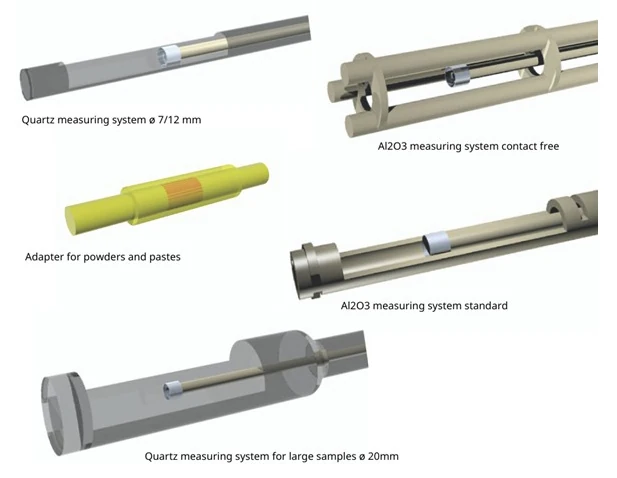
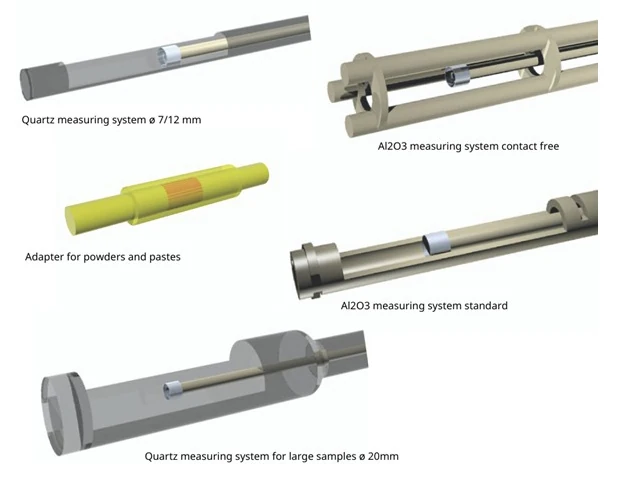
- Different types (designs/materials) of sample holders
- Caliper for online entry of the sample length
- Turntable for multi-furnace configuration
- Selection of gas boxes for up to 4 gases
- Ability to operate under H2
Accessories and Software
All LINSEIS thermal analysis instruments are PC-controlled. The individual software modules run exclusively under Microsoft® Windows® operating systems. The complete software consists of 3 modules: temperature control, data acquisition and data evaluation. The 32-bit software contains all essential functions for preparing, running and evaluating a measurement. LINSEIS specialists and application experts developed comprehensive, easy-to-understand, user-friendly application software.
General Features
- Text-editing program
- Data protection in case of power failure
- Thermocouple break protection
- Repeat measurements with minimal parameter input
- Evaluation of current measurement
- Curve comparison of up to 32 curves
- Storage and export of evaluations
- Export and import of data in ASCII
- Data export to MS Excel
- Analysis with multiple methods (DSC, TG, TMA, DIL, etc.)
- Zoom function
- 1st and 2nd derivative
- Programmable gas control
- Statistical evaluation package
- Free scaling
DIL Functions
- Evaluation of glass transition and softening point
- Softening point detection with automatic software-controlled system shutdown
- Display of relative/absolute shrinkage or expansion curves
- Presentation and calculation of the technical / physical expansion coefficient
- Rate Controlled Sintering (RCS) software
- Evaluation of the sintering process
- Semi-automatic evaluation functions
- Various system correction functions
- Automatic zero-point adjustment
- Automatic software-controlled adjustment of the sample pressure