LFA L51 Light Flash Analyzer
Reference: LINS-LFA L51
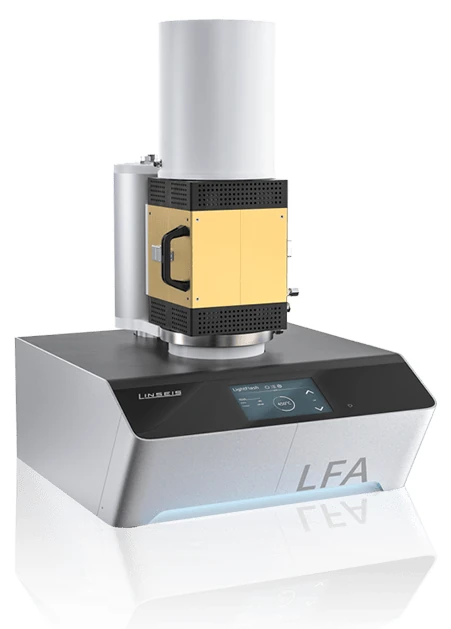
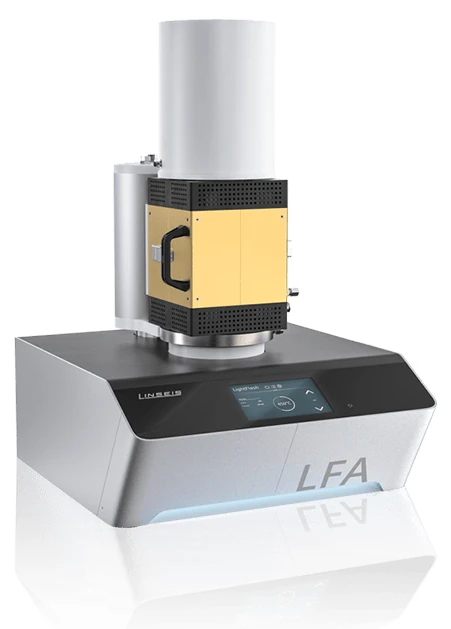
https://www.analis.com/shop/lins-lfa-l51-light-flash-analyzer-147787 https://www.analis.com/web/image/product.template/147787/image_1920?unique=ad3a0d8The LINSEIS LFA L51 Light Flash is a versatile light flash analyzer for measuring thermal diffusivity, thermal conductivity and specific heat on up to 18 samples at once. The flash method has become the most widely used technique for measuring thermal diffusivity and conductivity of solids, powders and liquids, as understanding thermophysical properties and optimizing heat transfer becomes increasingly important in industry.
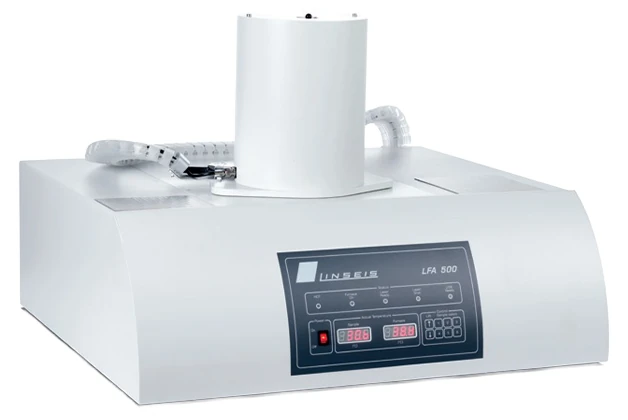
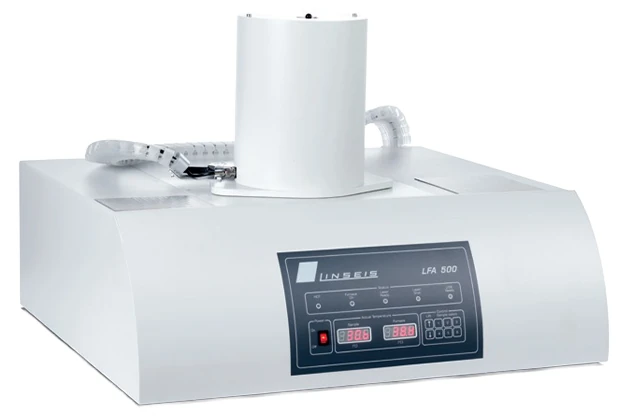
The LFA L51 is the official successor to the LINSEIS LFA 500, with a modernized housing, improved electronics, additional functions and updated nomenclature.
What does the LFA L51 measure?
The LFA 500 measures thermal diffusivity, from which thermal conductivity is derived, and determines specific heat by the comparative method. It handles a wide range of sample types, solids, liquids, powders, pastes and thin films, and performs multilayer analysis including contact-resistance determination in multilayer systems.
How does it work?
A light flash heats one face of the sample with a software-controlled variable pulse energy up to 15 J/pulse, and the temperature rise on the opposite face gives the thermal diffusivity. Three measurements benefit from advanced evaluation models, finite-pulse correction, heat-loss correction, the multilayer model and the Dusza model, with a model wizard to select the right one. An automated sample robot runs up to 18 samples over a temperature range of RT to 1500 °C.
Key advantages
- Up to 18 samples at once with a controllable sample robot and a fully automated measurement procedure
- Wide range of sample types: solids, liquids, powders, pastes, thin films and more
- Temperature range RT to 1500 °C with pulse energy up to 15 J/pulse (software-controlled variable pulse energy)
- Advanced evaluation models including finite-pulse correction, heat-loss correction, multilayer model and the Dusza model
- Model wizard to select the right evaluation model
- Specific heat determination by comparative method
- Contact-resistance determination in multilayer systems
Suitable for
- Glass ceramics such as BCR 724
- Graphite reference and reproducibility studies
- Solids, liquids, powders, pastes and thin films
Request a demonstration or quote
Download the brochure below for full specifications. Ask Analis’ local Benelux experts for more information, a demonstration, or a personalized quote.
Technical information
Category | Specification |
Temperature range | RT to 1500 °C |
Heating rate | 0.01 to 300 °C/min |
Pulse energy | Up to 15 J/pulse (variable pulse energy: software-controlled) |
Measuring range alpha | 0.01 to 2000 mm²/s |
Measuring range lambda | 0.1 to 4000 W/(m·K) |
Samples | Solids, liquids, powders, pastes, thin films and more |
Sample thickness | From thin films up to 6 mm high |
Sample holder | Graphite, SiC, Al2O3, metal (others on request) |
Software
All LINSEIS thermal analysis instruments are PC-controlled. The individual software modules run exclusively under Microsoft® Windows® operating systems. The complete software consists of three modules: temperature control, data acquisition and data evaluation. The Linseis 32-bit software has all essential features for preparing, running and evaluating measurements.
LFA functions
- Accurate pulse length correction, pulse mapping
- Heat loss corrections
- Analysis of 2- or 3-layer systems
- Dusza model for simultaneous finite pulse and heat loss correction
- Wizard for selecting the best evaluation model
- Determination of specific heat
- Determination of contact resistance in multilayer systems
Evaluation software
- Automatic or manual entry of related measurement data (density, specific heat)
- Model wizard for selecting the right model
- Finite pulse correction
- Heat loss correction
- Multilayer model
- Contact resistance determination
- Cp (specific heat) determination by comparative method
Measurement software
- Simple and user-friendly data entry for temperature segments, gases, etc.
- Controllable sample robot
- Software automatically displays corrected measurements after the energy pulse
- Fully automated measurement procedure for multiple-sample measurements
Application Examples
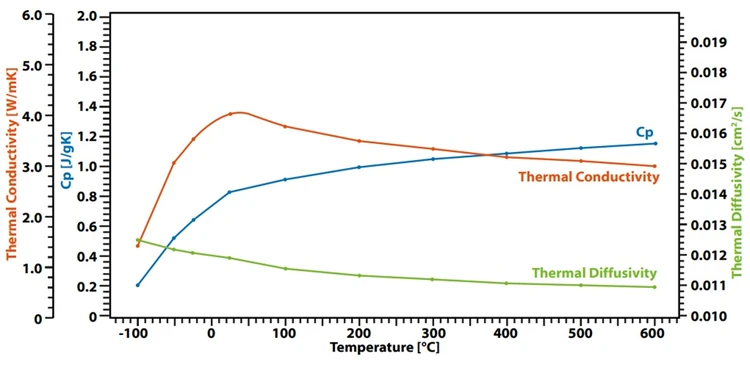
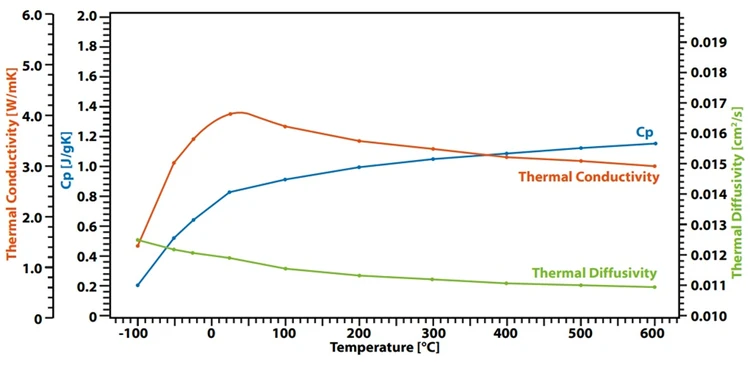
BCR 724 glass ceramic. BCR 724, a standard glass ceramic, was measured with the LFA 500. A small disc with a thickness of 1 mm and a diameter of 25 mm was cut from a bulk plate and coated with graphite for the measurement. The LFA 500 displays the thermal diffusivity as a direct function of temperature. The Cp data were obtained by the comparative method, by measuring a known ceramic standard under the same conditions in a second sample position of the same sample holder. The thermal conductivity was then calculated from the product of density, specific heat and thermal diffusivity. The result shows a slightly decreasing thermal diffusivity and conductivity, while the Cp value increases as temperature increases.
Graphite reference, reproducibility study. A graphite sample was examined with the LFA 500. The thermal diffusivity was determined directly at different temperatures between RT and 1100 °C. The specific heat capacity was determined using a known graphite standard in a second sample position as reference in the same measurement. The product of diffusivity, specific heat and density gives the corresponding thermal conductivity. The result shows a linearly decreasing thermal conductivity, which is typical, and a thermal diffusivity that reaches a plateau above 500 °C. Cp increases slightly as temperature rises.