- Analytical chemistry
- Automated Liquid Handling
- Capillary Electrophoresis
- Cell culture and Fermentation
- Cell health
- Centrifugation
- Chromatography (flash & prep)
- Cleaning
- Clinical Automation (TLA)
- Clinical IT solutions
- Clinical chemistry
- Clinical quality controls
- Color-Appearance and Physical tests
- DNA / RNA (Nucleic acids)
- Disinfection
- Electrochemistry
- Environmental monitoring
- Flow cytometry
- Flow cytometry Cell sorting
- Freeze drying
- Heating & cooling
- Hematology
- Imaging
- Immuno-Hematology
- Immunoassay
- In Vitro Fertilization (IVF)
- Lab furniture & design studies
- Liquid Handling (Manual)
- Mass spectrometers
- Material testing & characterization
- Metrology
- Microbiology (Clinical)
- Microscopy
- Moisture analysis
- Nephelometry
- POCT
- Particle characterization
- Platelet aggregation
- Protection cabinets
- Pumping
- Rheometers
- Sample preparation
- Shakers and stirrers
- Sterilization
- Storage
- Synthesis
- Tablet testing
- Texture analyzers
- Thermal analysis
- Toxicology
- Urine analysis
- Viscometers
- Water purification
- Weighing
- Thermal analysis Thermomechanical Analysis (TMA)
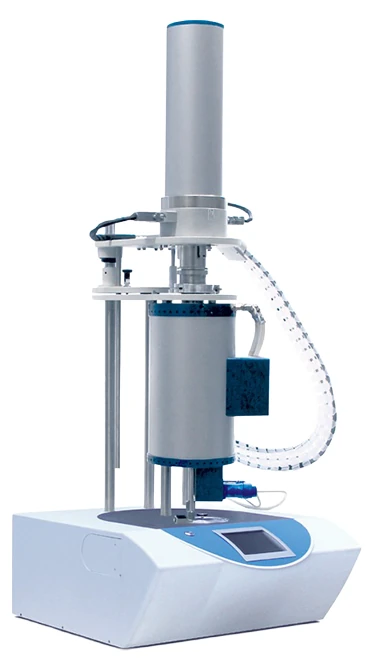
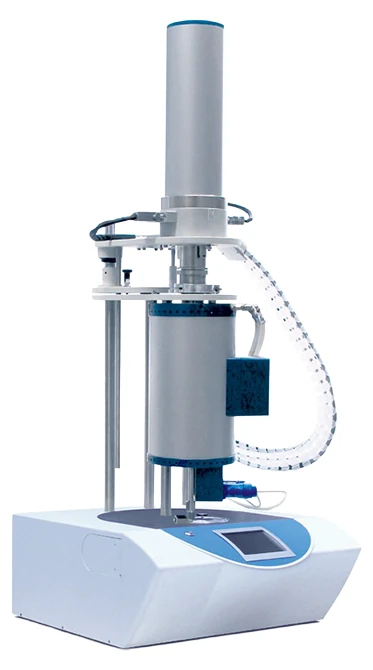
- TMA PT 1600 Thermomechanical Analyzer
HOME / APPLICATIONS & TECHNIQUES /
TMA PT 1600 Thermomechanical Analyzer
Reference: LINS-TMA L72
https://www.analis.com/shop/lins-tma-l72-tma-pt-1600-thermomechanical-analyzer-147803 https://www.analis.com/web/image/product.template/147803/image_1920?unique=ad3a0d8The LINSEIS TMA PT 1600 is a thermomechanical analyzer (TMA) built for high precision, reproducibility and accuracy. It performs a wide range of thermomechanical experiments on different sample shapes and sizes across a broad temperature range, up to 1600 °C, to cover the full spectrum of TMA applications.
A built-in force/frequency generator lets the system run both static and dynamic measurements on materials such as composites, glass, polymers, ceramics and metals.
What does the TMA PT 1600 measure?
Thermomechanical analysis measures dimensional changes of a material as a function of temperature, such as expansion, softening and transitions. The TMA PT 1600 resolves these changes down to 0.125 nm and performs both static and dynamic experiments, with measuring systems for sample geometries including fibers, rods, films, bars and cylinders.
How does it work?
The integrated force/frequency generator applies controlled static or dynamic load while temperature is varied up to 1600 °C. Dedicated functions include Rate Controlled Sintering (RCS) software for evaluating the sintering process, and softening-point detection with automatic, software-controlled system shutdown.
Key advantages
- Static and dynamic measurements with a built-in force/frequency generator
- Wide temperature range up to 1600 °C
- Variety of measuring systems for sample geometries such as fibers, rods, films, bars or cylinders
- Resolution of 0.125 nm
- Rate Controlled Sintering (RCS) software and evaluation of the sintering process
- Softening point detection with automatic software-controlled system shutdown
Suitable for
- Composites, glass, polymers, ceramics and metals
- Elastomers, such as polyurethane elastomers (glass transition detected at 29.9 °C in the application example)
- Rigid polyurethane foams, including as thermal insulation
Request a demonstration or quote
Ask Analis’ local Benelux experts for more information, a demonstration, or a personalized quote.
Technical information
Category | Specification |
Temperature range | RT to 1600 °C |
Sample size | 30 mm |
Force | Up to 1 / 5.7 / 20 N |
Frequency | 1 Hz |
Resolution | 0.125 nm |
Atmospheres | Reducing [rood], inert, oxidizing, vacuum; static/dynamic |
Software
All LINSEIS thermal analysis instruments are PC-controlled. The individual software modules run exclusively under Microsoft® Windows® operating systems. The complete software consists of 3 modules: temperature control, data acquisition and data evaluation. The 32-bit software contains all essential functions for preparing, running and evaluating a thermogravimetric measurement. Together with specialists and application experts, LINSEIS developed comprehensive, easy-to-understand and user-friendly application software.
TMA functions
- Evaluation of glass transition and softening point
- Softening point detection with automatic software-controlled system shutdown
- Display of relative/absolute shrinkage or expansion curves
- Presentation and calculation of the technical / physical expansion coefficient
- Rate Controlled Sintering (RCS) software
- Evaluation of the sintering process
- Semi-automatic evaluation functions
- Various system correction functions
- Automatic zero-point adjustment
- Automatic software-controlled adjustment of the sample pressure
General software features
- Text-editing program
- Data protection on power failure
- Thermocouple break protection
- Repeat measurements with minimal parameter input
- Evaluation of ongoing measurement
- Curve comparison of up to 32 curves
- Storage and export of evaluations
- ASCII data export and import
- Data export to MS Excel
- Analysis with multiple methods (DSC, TG, TMA, DIL, etc.)
- Zoom function
- 1st and 2nd derivative
- Programmable gas control
- Statistical evaluation package
- Free scaling
Application Example
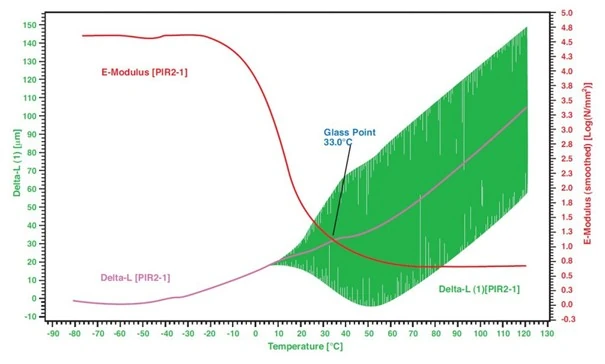
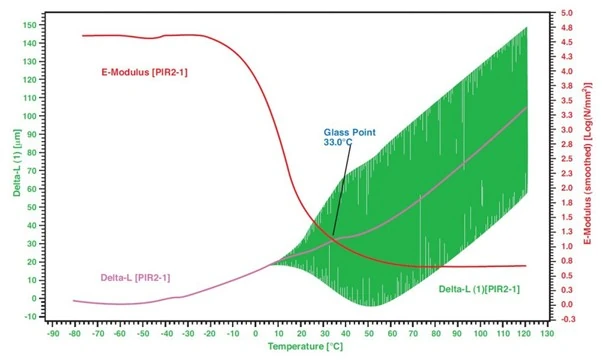
Elastomer (in this case not high temperature). Because of their special and versatile properties, polyurethane elastomers are widely used in almost every industry, from the automotive, electrical and electronics, design and textile industries to mining and heavy industry. This evaluation covers elastomers developed for applications above 0 °C. The glass point was detected at 29.9 °C. As the temperature increases further, additional expansion of the material occurs in the elastic range. In this evaluation, the plastic range of the material is not reached.
Published studies using the instrument
- Preparation of rigid polyurethane foam as internally moistened thermal insulation (published in AIP Conference Proceedings)
- Rigid polyurethane foams as cryogenic insulation of external tanks for space launch vehicles (published in IOP Conference Series: Materials Science and Engineering)
Automated Liquid Handling
Capillary Electrophoresis
Cell culture and Fermentation
Cell health
Centrifugation
Chromatography (flash & prep)
Cleaning
Clinical Automation (TLA)
Clinical IT solutions
Clinical chemistry
Clinical quality controls
Color-Appearance and Physical tests
DNA / RNA (Nucleic acids)
Disinfection
Electrochemistry
Environmental monitoring
Flow cytometry
Flow cytometry Cell sorting
Freeze drying
Heating & cooling
Hematology
Imaging
Immuno-Hematology
Immunoassay
In Vitro Fertilization (IVF)
Lab furniture & design studies
Liquid Handling (Manual)
Mass spectrometers
Material testing & characterization
Metrology
Microbiology (Clinical)
Microscopy
Moisture analysis
Nephelometry
POCT
Particle characterization
Platelet aggregation
Protection cabinets
Pumping
Rheometers
Sample preparation
Shakers and stirrers
Sterilization
Storage
Synthesis
Tablet testing
Texture analyzers
Thermal analysis
Toxicology
Urine analysis
Viscometers
Water purification
Weighing