- Analytical chemistry
- Automated Liquid Handling
- Capillary Electrophoresis
- Cell culture and Fermentation
- Cell health
- Centrifugation
- Chromatography (flash & prep)
- Cleaning
- Clinical Automation (TLA)
- Clinical IT solutions
- Clinical chemistry
- Clinical quality controls
- Color-Appearance and Physical tests
- DNA / RNA (Nucleic acids)
- Disinfection
- Electrochemistry
- Environmental monitoring
- Flow cytometry
- Flow cytometry Cell sorting
- Freeze drying
- Heating & cooling
- Hematology
- Imaging
- Immuno-Hematology
- Immunoassay
- In Vitro Fertilization (IVF)
- Lab furniture & design studies
- Liquid Handling (Manual)
- Mass spectrometers
- Material testing & characterization
- Metrology
- Microbiology (Clinical)
- Microscopy
- Moisture analysis
- Nephelometry
- POCT
- Particle characterization
- Platelet aggregation
- Protection cabinets
- Pumping
- Rheometers
- Sample preparation
- Shakers and stirrers
- Sterilization
- Storage
- Synthesis
- Tablet testing
- Texture analyzers
- Thermal analysis
- Toxicology
- Urine analysis
- Viscometers
- Water purification
- Weighing
- Material testing & characterization Surface Tension Analysis
- SITA FoamTester
HOME / APPLICATIONS & TECHNIQUES /
SITA FoamTester
Reference: SIT-101620
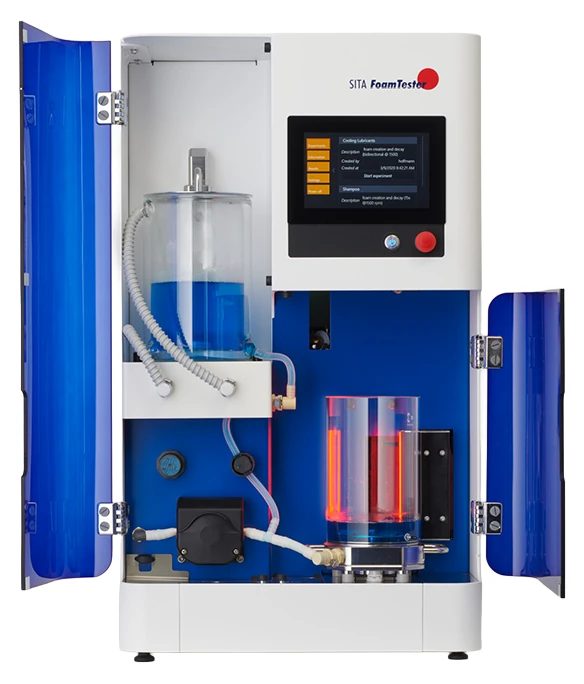
https://www.analis.com/shop/sit-101620-sita-foamtester-145409 https://www.analis.com/web/image/product.template/145409/image_1920?unique=ad3a0d8The SITA FoamTester creates, measures and analyzes foam in a single instrument, so you can understand foam formation and stability across a wide range of products. It is used in many industries and suits both beginners and experienced professionals.
Its modular design can be extended with foam structure analysis (hardware and software) to become a fully automatic foam tester that runs every step, from sample preparation and foam analysis to cleaning, tasks that used to be manual.
What does the SITA FoamTester measure?
The FoamTester quantifies foam formation, foam stability and foam structure, giving immediate insight into the reproducibility of the foam. Autonomous repeat measurements run without user intervention, which reduces operator influence and makes screening of test and sample parameters fast and simple.
How does it work?
A glass measuring vessel (200–500 ml) with a patented stirrer (max. 2,000 rpm) generates foam accurately at temperatures from 0 °C to 60 °C and at different surfactant concentrations. A liquid reservoir with a magnetic stirrer enables several measurements in a row, and the fully automatic version carries out preparation, analysis and cleaning on its own.
Key advantages
- Modular design extendable with foam structure analysis (hardware and software)
- Fully automatic operation from sample preparation to foam analysis to cleaning
- Autonomous repeat measurements without user intervention
- Reduced user influence on the measurements
- Immediate insight into the reproducibility of the foam
- Quick, simple screening of test and sample parameters
What can you use it for?
Foam behavior matters across many sectors:
- Cosmetics — influence of formulation and raw materials on foam behavior; foam stability of toothpaste, soap and shampoo; foam structure as a reference for user perception
- Cooling lubricants — influence of water hardness on aging; durability of de-foamers
- Inks, paints and coatings — effectiveness of de-foamers
- Cleaning agents — influence of temperature on spray cleaners and installations; influence of contaminants on foam in cleaning baths
- Liquids industry — foam disruptions in the paper industry; recipe and production optimization to reduce foaming when pumping; reduced foaming when filling bottles, reservoirs, containers and barrels; foaming additives in textile production; foaming effects of polymers in plastics production
Request a demonstration or quote
Download the brochure below for full specifications. Ask Analis’ local Benelux experts for more information, a demonstration, or a personalized quote.
Technical information
Category | Specification |
Power supply | 220 / 50 Hz, 300 W |
PC interface | Ethernet |
Dimensions (H x W x D) | 770 x 450 x 305 mm |
Weight | 35 kg |
Recommended sample volume for foam generation | 200 ... 500 ml |
Foam reservoir content | 1,500 ml (incl. foam) |
Foam reservoir dimensions | 180 mm (h) and 110 mm ⌀ |
Foam reservoir capacity | 2000 ml |
Temperature range | 0 to 60 °C, using an optional sample reservoir thermostat |
Stirring speed | 0 to 2,000 rpm, with duration, direction and acceleration |
Foam volume analysis (foam formation and decay) | Total volume, foam volume, liquid volume |
Parameters | Max. foam volume, foam half-life and flash foam |
Total volume measuring range | 0 to 1,500 ml |
Resolution | 1 ml |
Liquid volume | 0 to 500 ml |
Foam structure parameters analysis | Number of bubbles, bubble size distribution, mean bubble diameter, roundness |
Measuring area | Height 130 mm, width 50 mm |
Software
Windows software SITA-FoamLab
- Convenient evaluation of measurement data with SITA-FoamLab in the lab and the office
- Full transparency of measurement progress and results through intuitive visualization
- Analysis of the rising slope (volume increase) and the final volume during foam formation
- Analysis of foam decay and drainage
- Analysis of bubble/cell sizes and shapes in the foam structure
Extensive characterization of foam and foam behavior by
- determining further parameters such as half-life period and foam density;
- individual height-dependent evaluation of foam structure parameters such as mean bubble size or circularity index;
- monitoring time-dependent changes in the foam structure;
- flexible comparison and display of different measurement results;
- easy export of data and results for documentation and storage.
Automated Liquid Handling
Capillary Electrophoresis
Cell culture and Fermentation
Cell health
Centrifugation
Chromatography (flash & prep)
Cleaning
Clinical Automation (TLA)
Clinical IT solutions
Clinical chemistry
Clinical quality controls
Color-Appearance and Physical tests
DNA / RNA (Nucleic acids)
Disinfection
Electrochemistry
Environmental monitoring
Flow cytometry
Flow cytometry Cell sorting
Freeze drying
Heating & cooling
Hematology
Imaging
Immuno-Hematology
Immunoassay
In Vitro Fertilization (IVF)
Lab furniture & design studies
Liquid Handling (Manual)
Mass spectrometers
Material testing & characterization
Metrology
Microbiology (Clinical)
Microscopy
Moisture analysis
Nephelometry
POCT
Particle characterization
Platelet aggregation
Protection cabinets
Pumping
Rheometers
Sample preparation
Shakers and stirrers
Sterilization
Storage
Synthesis
Tablet testing
Texture analyzers
Thermal analysis
Toxicology
Urine analysis
Viscometers
Water purification
Weighing