Towards a new generation of urinary sediment analysis: optimising the detection of urinary crystals on the FUS3000plus platform through collaboration between Liège University Hospital, Analis and Dirui
June 2026 - Interview of Romy Gadisseur - CHU Liège - www.chuliege.be
Download this case study below
_______________________________________________________________
INTRODUCTION
Reliably identifying urinary crystals remains a challenge for many laboratories. Thanks to a collaboration between the University Hospital of Liège, Dirui, and Analis, the FUS3000plus urine analysis platform now features significant improvements in the automatic recognition of urinary crystals using AI.
With more than 1,000 beds and a world-class diagnostic laboratory, the University Hospital of Liège is recognised as one of Belgium’s leading university hospitals, with significant expertise in analysing urinary sediments and recognising urinary crystals.
This scientific expertise forms the basis of the collaborative project developed with our supplier and partner Dirui, a leading Chinese company that specialises in automated in vitro diagnostic solutions.
The goal of this three-way collaboration: CHU Liège - Dirui - Analis
is to improve the FUS3000plus software by developing new categories of urinary crystal image recognition using artificial intelligence. In this international project, Analis serves as the scientific and operational coordinator between the Belgian and Chinese teams, facilitating project oversight, technical exchanges, and the integration of real-world needs into the development of future algorithms.
Results achieved:
The combined expertise of Romy Gadisseur and Tugba Yilmaz from the University Hospital of Liège, together with Dirui’s R&D team, represented by Yuru Clare Lin, Scientific Affairs Manager at Dirui, has made it possible to:
- Improve the recognition of uric acid and ammonium magnesium phosphate crystals.
- Distinguish between monohydrate and dihydrate oxalates.
- Add new crystal categories such as cystine, brushite, and ammonium urate.
- Optimize recognition algorithms using data validated under real-world laboratory conditions.
A Breakthrough for the Laboratory
The integration of AI into urinary sediment analysis helps improve the consistency of results, facilitates the identification of complex crystals, and supports laboratory teams in their routine activities.
Clinical expertise at the heart of development
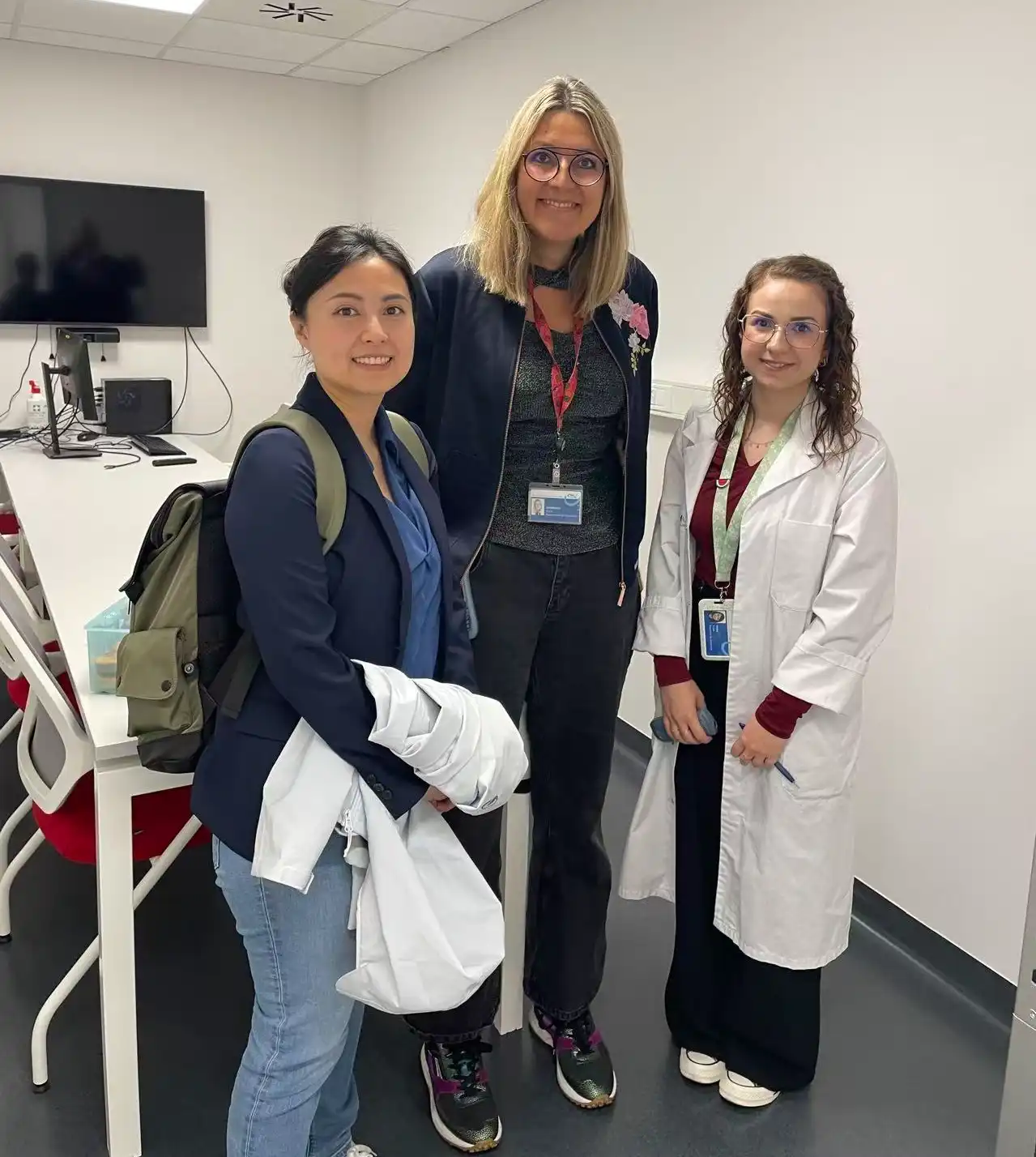
The project was coordinated at the University Hospital of Liège by Romy Gadisseur, a clinical biologist recognized for her expertise in clinical biology and, more specifically, in the field of crystalluria. She also received support from Tugba Yilmaz, a scientist at the University Hospital of Liège. Together, they played an essential role in the development and success of this ambitious project
From left to the right:
Yuru Clare Lin - Dirui Scientific Affairs Manager
and
Romy
Gadisseur and Tugba Yilmaz of the CHU Liège
This collaborative approach allowed for the direct involvement of end users in the development and validation of the algorithms, ensuring a better alignment with real-world needs. The direct involvement of biologists in the development and validation of the algorithms is essential to ensure their relevance in day-to-day diagnostic practice
The work carried out by the Liège University Hospital, Analis and Dirui goes far beyond a simple software update. It illustrates how structured collaboration between end-users, the distributor and the manufacturer can accelerate the responsible integration of AI into clinical diagnosis.
By involving experienced clinical biologists at every stage of algorithm development, this project sets a new standard for the validation of AI in urinary sediment analysis. The forthcoming scientific publication will soon formalise and more widely disseminate these advances.
Whether you manage a high-throughput hospital laboratory or a specialist urology unit, the FUS3000plus platform now offers a validated, AI-assisted pathway to more accurate and harmonised crystalluria results.
The full findings of this work will be presented at the
Microbiology
& Urinalysis Scientific Seminar
on 26 November 2026 at Kinepolis
ImagiBraine.
JOIN US THE 26 NOVEMBER & BOOK YOUR SEAT