
HOME / APPLICATIONS & TECHNIQUES /
Cryogenic freezers
Request more informationWhat is a cryogenic freezer?
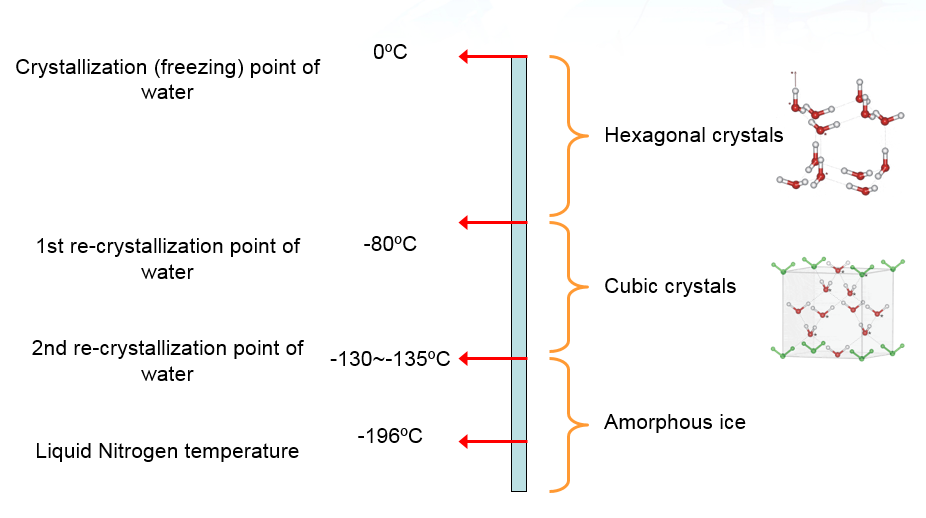
A cryogenic freezer is a freezer that uses liquid nitrogen as a cooling agent for long term storage of biological samples. Liquid nitrogen has an evaporation temperature at -196°C. The second crystallisation point of water is approximately -130°C. When samples are stored below this point, the ice becomes amorphous, and the biological activity is completely shut down. Cryogenic freezers are in general used to store samples for an infinite period of time.
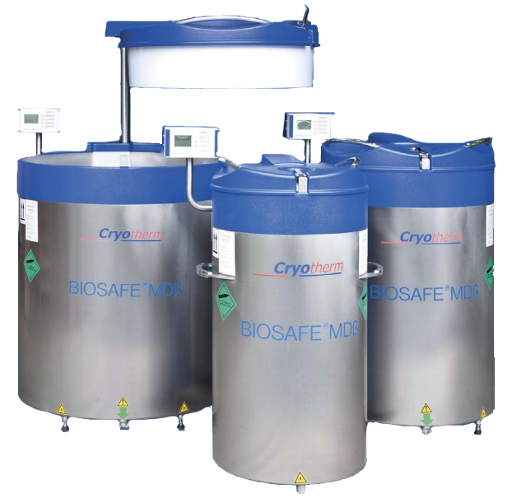
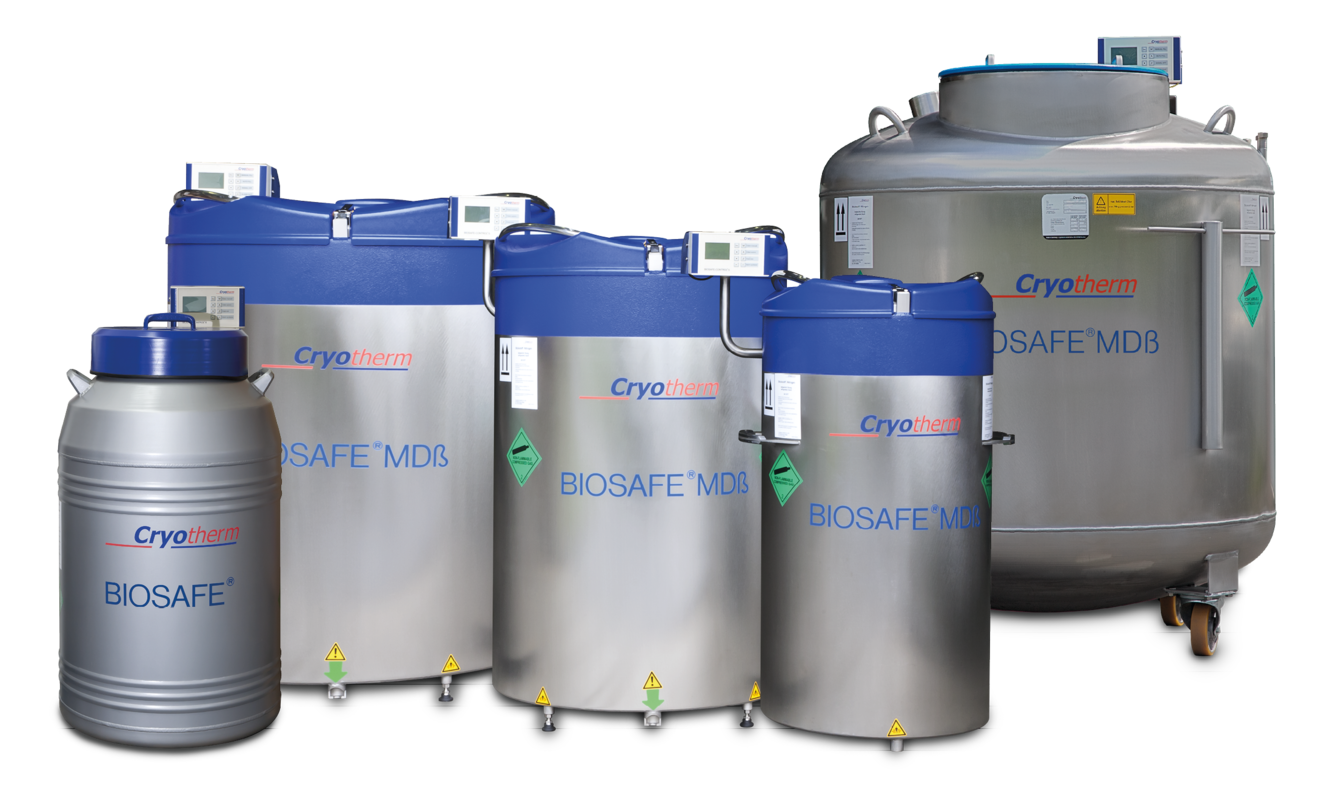
BIOSAFE 120 - 220 - 420
Available in different sizes and designs, and supplemented by extensive accessories, the Cryotherm BIOSAFE® offers a complete solution for your cryo-preservation activities.
Substance LIN
Temperature to -196 °C
Application scope:
MEDICINE - BIOBANKS BIOREPOSITORY - LOW TEMPERATURE HUMAN SAMPLES - STORAGE OF ENVIRONMENTAL SAMPLES
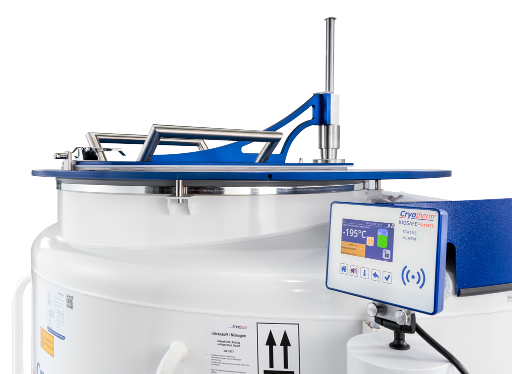
BIOSAFE 500 - 800 - 2400
Cryocooler for cryopreservation:
BIOSAFE® liquid nitrogen freezer
Substance LIN
Temperature to -196 °C
Application scope:
MEDICINE - BIOBANKS BIOREPOSITORY - LOW TEMPERATURE HUMAN SAMPLES - STORAGE OF ENVIRONMENTAL SAMPLES
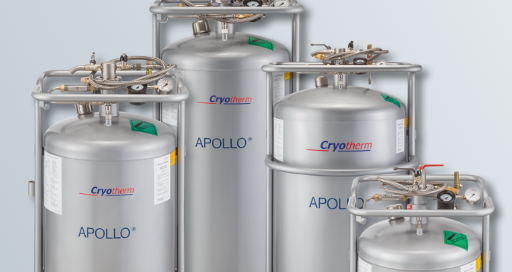
APOLLO Series
Liquid nitrogen dewar for cryogenic storage.
Mobile storage tank for cryogenic liquefied nitrogen. With vacuum super insulation and long-term vacuum protection. Approved according to the European Pressure Equipment Directive PED. Transport in unpressurized condition with transport plug fitted.
Substance LINLAR
Temperature to -196 °C
Application scope:
LABORATORY & COLD MILLING
What is the difference between gas phase and liquid phase cryogenic storage?
Traditionally, liquid phase cryogenic storage was the most used because of the idea that this storage type has better temperature homogeneity. More recently, the realization came that homogeneity is not that important if you stay below the second crystallization point. Gas phase storage has the advantage of being the safer alternative, because your samples are not directly in liquid nitrogen. This reduces the risks for the operator that come with handling liquid nitrogen, like frost burns.
What is a biobank?
A biobank is a collection of biological samples and their data. A biobank can be a collection stored in multiple cryogenic vessels.
Related product categories
Automated Liquid Handling
Capillary Electrophoresis
Cell culture and Fermentation
Cell health
Centrifugation
Chromatography (flash & prep)
Cleaning
Clinical Automation (TLA)
Clinical IT solutions
Clinical chemistry
Clinical quality controls
Color-Appearance and Physical tests
DNA / RNA (Nucleic acids)
Disinfection
Electrochemistry
Environmental monitoring
Flow cytometry
Flow cytometry Cell sorting
Freeze drying
Heating & cooling
Hematology
Imaging
Immuno-Hematology
Immunoassay
In Vitro Fertilization (IVF)
Lab furniture & design studies
Liquid Handling (Manual)
Mass spectrometers
Material testing & characterization
Metrology
Microbiology (Clinical)
Microscopy
Moisture analysis
Nephelometry
POCT
Particle characterization
Platelet aggregation
Protection cabinets
Pumping
Rheometers
Sample preparation
Shakers and stirrers
Sterilization
Storage
Synthesis
Tablet testing
Texture analyzers
Toxicology
Urine analysis
Viscometers
Water purification
Weighing