High-Pressure STA HP 3
Reference: LINS-STA L85
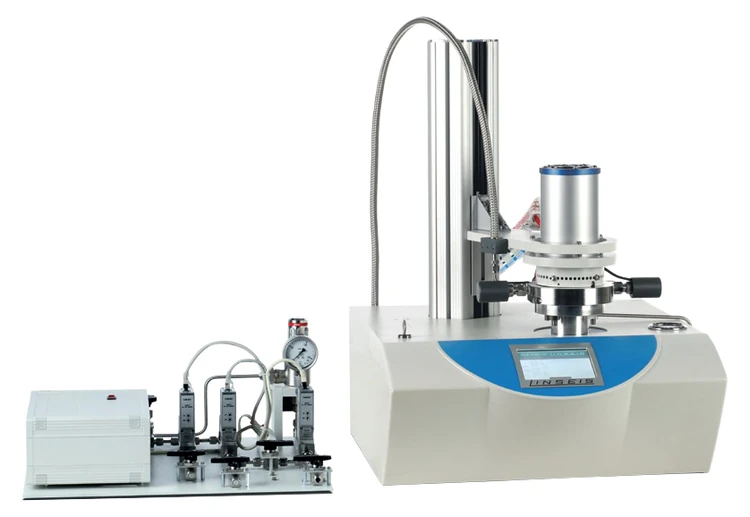
https://www.analis.com/shop/lins-sta-l85-high-pressure-sta-hp-3-147783 https://www.analis.com/web/image/product.template/147783/image_1920?unique=ad3a0d8The LINSEIS STA HP 3 is a benchtop high-pressure simultaneous thermal analyzer (STA) combining thermogravimetry and DSC (TGA-DSC), built on 25 years of experience in thermal analysis under pressure. It runs experiments up to 1200 °C and up to 150 bar in reactive or inert atmospheres.
A high-speed micro furnace, a top-loading microbalance and a true TG-DSC design measure mass change and calorimetric events in a single run, under identical temperature, gas and pressure conditions.
What does the STA HP 3 measure?
As a simultaneous thermal analyzer, it records mass change (TGA) and calorimetric events (DSC), such as endothermic or exothermic reactions and phase transitions, in one run on the same sample. Because the thermocouple is in direct contact with the sample, sample temperature is accurate, eliminating errors caused by the distance between sample and thermocouple.
What makes high-pressure STA different?
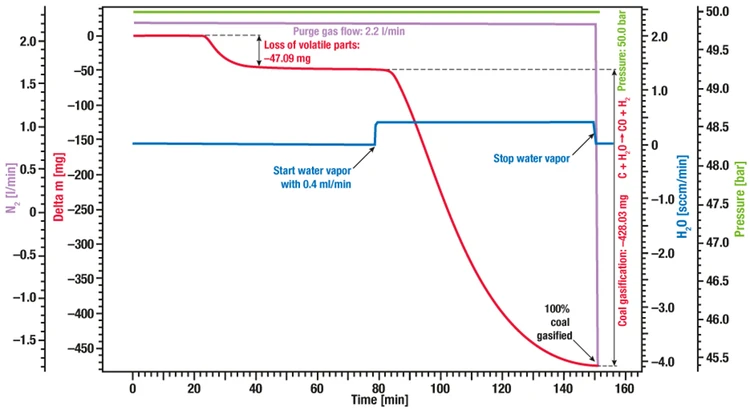
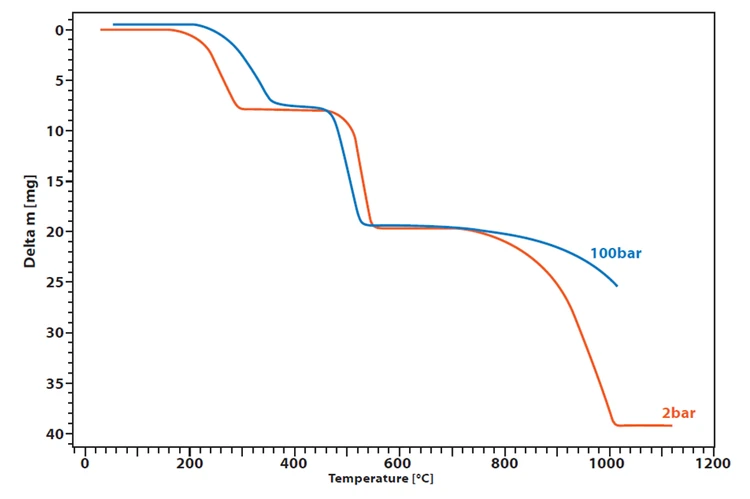
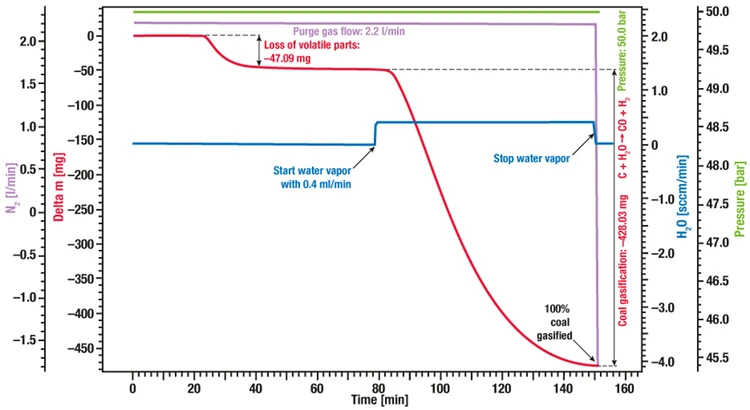
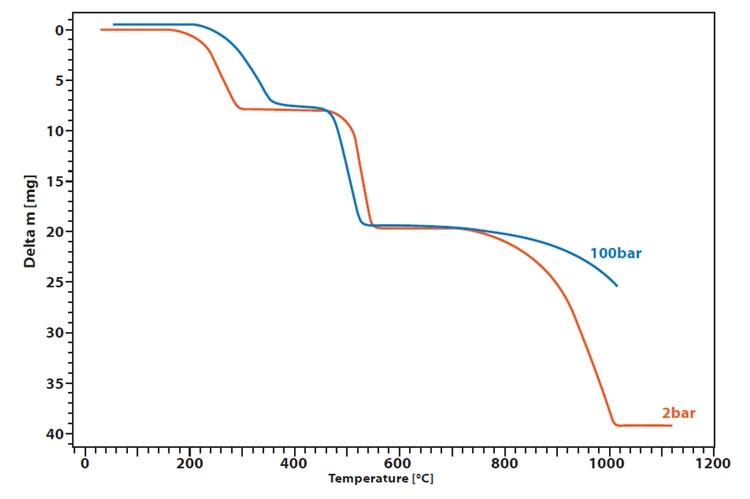
Running thermal analysis under pressure (up to 150 bar) shifts reaction equilibria and transition temperatures, which reveals behavior invisible at ambient pressure. For example, in the thermal decomposition of calcium oxalate monohydrate at 100 bar, water and CO₂ loss shift to higher temperatures than at 2 bar. High-pressure STA is therefore key to studies such as coal gasification (hydrogasification), where pressure determines the chemical equilibria in the production of CO, H₂, methanol and methane.
How does it work?
Plug-and-play sensors are user-exchangeable: TGA only (volumes up to 1 ml) or combined TGA-DSC (0.12 or 0.3 ml). The micro heater delivers controlled heating up to 300 °C/min and cooling up to 150 °C/min, and the small furnace volume enables fast gas changes with much lower gas and energy consumption. Flexible gas dosing handles up to 3 gases as standard (more on request), with an optional vapor generator and an automatic evacuation and gas-combustion safety system for gases such as hydrogen and hydrocarbons.
Key advantages
- Top-loading combined TG-DSC measures mass change and calorimetric events such as endothermic or exothermic reactions and phase transitions in one run, under the same temperature, gas and pressure conditions
- Plug-and-play sensors that the user exchanges easily: TGA only with volumes up to 1 ml, or combined TGA-DSC with a volume up to 0.12 or 0.3 ml
- Accurate sample temperature as the thermocouple is in direct contact with the sample, which eliminates errors from the distance between sample and thermocouple
- Fast heating and cooling with the micro heater, up to 300 °C/min controlled heating rate and up to 150 °C/min cooling rate
- Small furnace volume for fast gas changes and sharply lower gas and energy consumption
- Flexible gas dosing with panels designed to your needs: up to 3 gases as standard, more on request, an optional vapor generator and an automatic evacuation and gas combustion safety system for gases such as hydrogen and hydrocarbons
- Steam options with condensate traps, water vapor generators and heated transfer lines for steam and other condensing gases
- Tabletop design for maximum flexibility; all gas control panels meet high German quality and safety standards
Suitable for
The STA HP 3 also works at high pressure, for example 100 bar:
- Thermal decomposition of calcium oxalate monohydrate: DSC and TG signals in static nitrogen at 100 bar and 20 K/min up to 600 °C, compared with 2 bar. Water loss and CO₂ loss shift to later temperatures at higher pressure, while CO loss (an irreversible decomposition) is largely independent of pressure
- Coal gasification (hydrogasification): studying the reaction of carbon with water vapor, where pressure determines the position of the chemical equilibria in the production of CO, H₂, methanol and methane
Request a demonstration or quote
Ask Analis’ local Benelux experts for more information, a demonstration, or a personalized quote.
Technical information
Category | Specification |
Temperature range | RT to 1200 °C |
Max. pressure | 150 bar |
Vacuum | 10E-4 mbar |
TG sensors | Type E/K/S/B/C |
TG-DSC sensors | Type E/K/S/B/C |
Interface | USB or Ethernet |
Gas dosing | 1, 2 or 3 (more on request) |
Software
The new Platinum software streamlines your workflow, as its intuitive data processing requires only minimal parameter input. AutoEval guides the user through the evaluation of standard processes such as glass transitions or melting points. The Thermal Library Product Identification Tool provides a database of 600 polymers for automatic identification of your tested polymer. Instrument control and/or monitoring via mobile devices keeps you in control wherever you are.
Software features
- Software packages compatible with the latest Windows operating system
- Set-up menu items
- All specific measurement parameters (user, laboratory, sample, company, etc.)
- Optional password and user levels
- Undo and redo function for all steps
- Unlimited heating, cooling or dwell-time segments
- Multiple language versions such as English, German, French, Spanish, Chinese, Japanese, etc. (user-selectable)
- Evaluation software with a number of functions that allow complete evaluation of all types of data
- Multiple smoothing models
- Full evaluation history (all steps can be undone)
- Evaluation and data acquisition can run simultaneously
- Data can be corrected using zero and calibration correction
- Data evaluation includes: peak separation software, signal correction and smoothing, first and second derivative, curve arithmetic, data peak evaluation, glass point evaluation, slope correction; zoom / individual segment display, multiple curve overlay, annotation and drawing tools, copy-to-clipboard function, multiple export functions for graphics and data export, reference-based correction