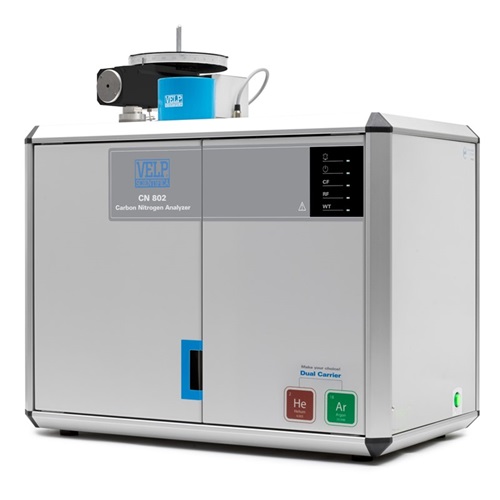
NDA 702 Dumas Nitrogen Analyzer
Reference: VEL-F30800080
https://www.analis.com/shop/vel-f30800080-nda-702-dumas-nitrogen-analyzer-123393 https://www.analis.com/web/image/product.template/123393/image_1920?unique=75194b1Built to maximize your productivity
The NDA 702 Dumas elemental analyzer suits high-throughput labs that need a fast, safe analyzer, with a choice of helium or argon as carrier gas.
Powered by DUMASoft™ software, the NDA 702 produces N/protein results in just 3 to 4 minutes, fully unsupervised and cloud-enabled.
The NDA 702 is much faster, easier and safer than a traditional Kjeldahl system.
It is a safe analyzer that needs no aggressive chemicals or time-consuming steps: just prepare your sample and walk away.
NDA 702 Nitrogen Analyzer Working Principle
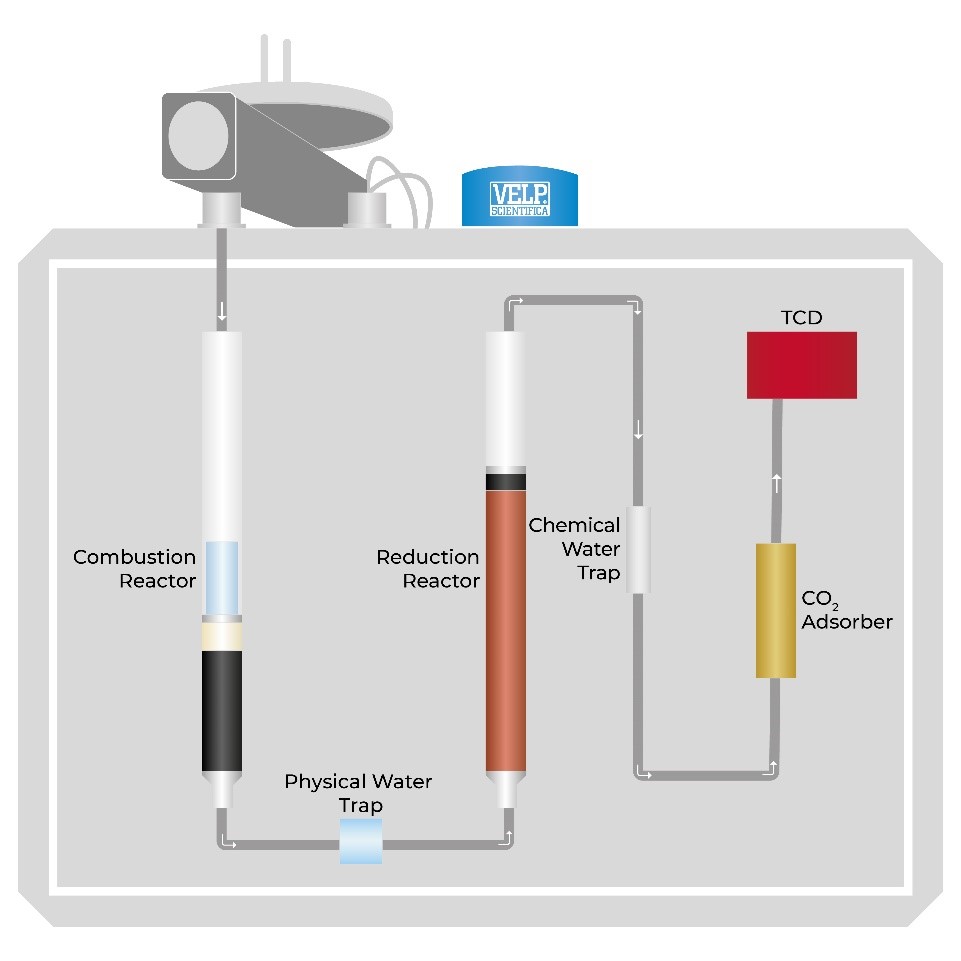
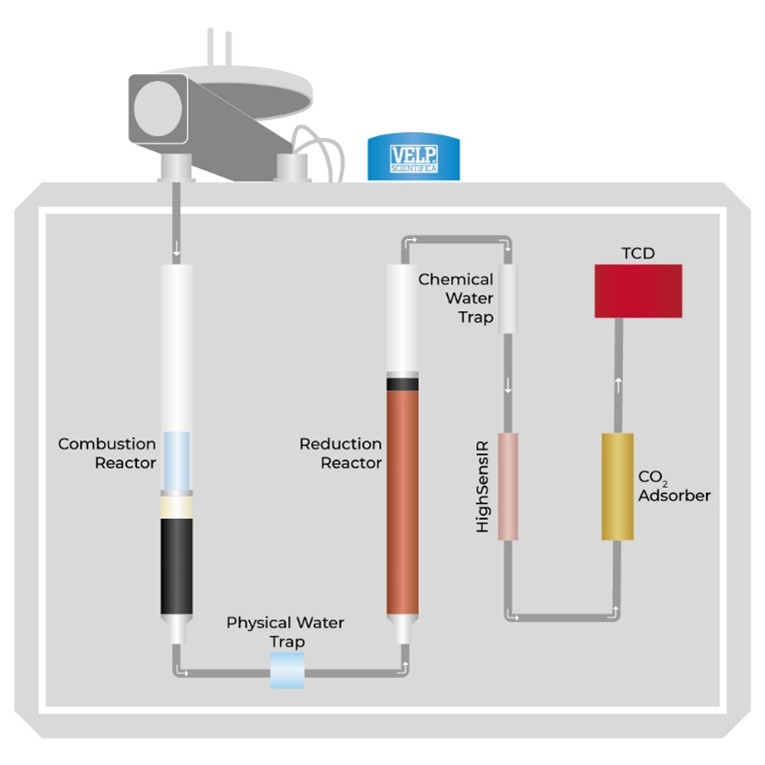
The Dumas method begins with combustion of the sample in the VELP combustion furnace (CF), above 1000 °C, to obtain elemental compounds.
Water is separated in two steps: first the maintenance-free physical trap DriStep™ (WT1) placed right after combustion, then a chemical trap (WT2) that removes the remaining 1% of water.
Between the two traps, the gas flow passes through the reduction furnace (RF), where NOx compounds are converted into molecular nitrogen (N2).
The CO2 is then trapped by the self-regenerating VELP CO2 adsorbers.
Finally, elemental nitrogen is detected by the TCD LoGas™ thermal conductivity detector, which sends the data to DUMASoft™ to calculate nitrogen and protein content.
Elemental Analysis and the Dumas Method
The Dumas method (combustion method) is a primary method for determining nitrogen and protein, offering fast results, ease of use and safety. It is considered an alternative to the classical Kjeldahl method. Both are validated by international bodies: Kjeldahl is recognized by AOAC, EPA, DIN, ISO and others, and Dumas by AOAC, AACC, ISO, DIN, ASBC, AOCS, OIV and others. In some countries, local guidelines recommend one method over the other.
The Dumas method for nitrogen determination (1831) is older than Kjeldahl (1883) but more convenient in many ways: speed, safety, cleanliness, productivity and cost per analysis.
In the past, the conditions the Dumas method requires were hard to reproduce, so Kjeldahl took the lead and became the classical method for nitrogen/protein determination.
Today, thanks to technological progress, Dumas nitrogen determination is becoming more widespread.
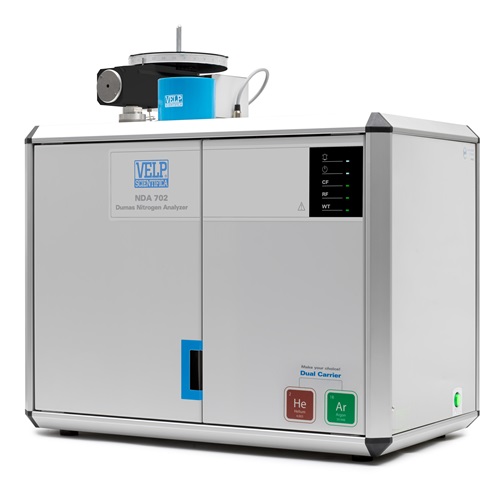
Technical information
|
Method of analysis: |
Nitrogen determination according to Dumas method (combustion) |
|
Analysis time: |
3/4 minutes |
|
Detector: |
TCD (Thermal Conductivity Detector) |
|
Sample weight: |
Up to 1 g |
|
Autosampler type: |
Electronic |
|
Autosampler capacity: |
Up to 4 discs, 30 positions each (up to 117 samples) |
|
Detection range N: |
ppm up to 200 mg abs. (or 100 %) |
|
Reproducibility (RSD): |
< 0.5% for EDTA standards (9.57%N) |
|
Recovery: |
> 99.5% |
|
Combustion temperature: |
1100 °C / 2012 °F |
|
Carrier gas: |
Helium or Argon (grade 5.0) |
|
Combustion gas: |
Oxygen (grade 5.0) |
|
Connectivity |
Ermes Cloud Platform via Wi-Fi or LAN connected to a PC |
|
Interfaces: |
USB; RS232 |
|
Weight: |
54 kg / 119 lb |
|
Dimensions (WxHxD): |
655x510x410
mm (H 690 mm with autosampler) |
|
21 CFR part 11 compliance: |
Yes, optional package available |
|
Official references: |
ISO 16634; ISO 14891; AOCS Ba 4e-93, AOAC 992.23; AACC 46-30; ICC 167, ASBC Barley 7C; AOCS Ba 4f-00; AOAC 992.15; ASBC AOAC 997.09; OIV-MA-AS323-02A; AOAC 990.03; AOAC 993.13; ISO 13878; EN 16168, etc. |