BeScan Lab+ – Determination of Dispersion Stability
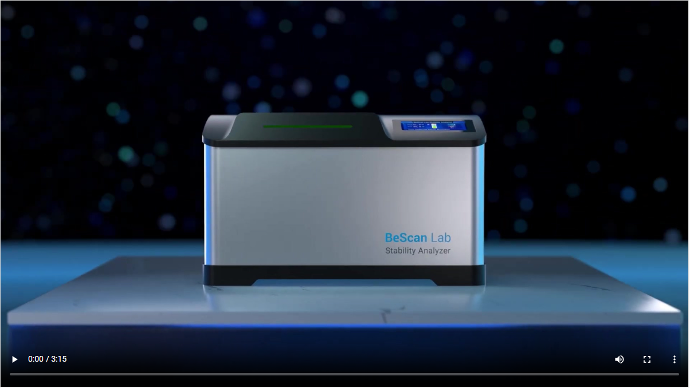
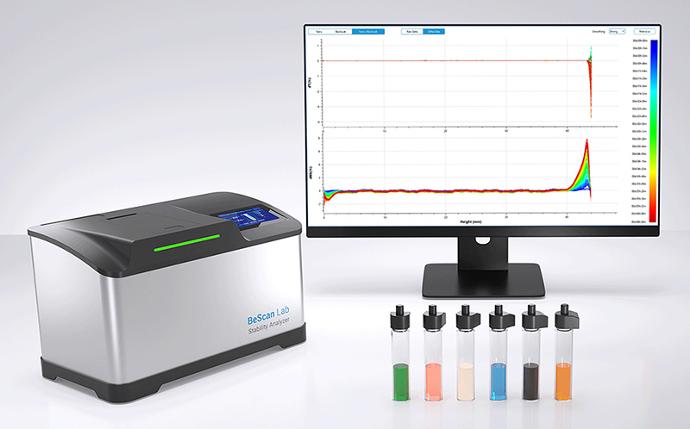
The BeScan Lab+ determines the stability of dispersions and formulations using static multiple light scattering (SMLS). Suspensions, emulsions and foams can be analysed in their original state (up to 95% by volume), at temperatures from 10 °C below ambient up to 80 °C.
It supports quality control of many formulations — for example to optimise storage stability — and the quantitative analysis of destabilization phenomena, formulation candidates and process conditions.
BeScan Lab+ - Ensuring Quality and Stability
The BeScan Lab+ delivers precise, reliable dispersion-stability control that meets the demands of many industries. It provides accurate native-state analysis and detects instability long before it is visible to the eye. AI-assisted interpretation helps identify instability mechanisms faster and more consistently.
The BeScan Lab+ supports the formulation, production and pre-use stages across the product lifecycle. It enables formulation optimisation, in-process quality control, studies of optimal transport and storage conditions, and redispersibility research — helping R&D and QC teams compare formulations, batches and stress conditions on an objective basis.
The BeScan Lab+ is built for precise dispersion-stability measurement, giving critical insight into colloidal systems through non-destructive SMLS profiles, the Instability Index (IUS), the Homogeneity Index (RSD), particle migration kinetics, in-situ particle size distribution and AI-assisted interpretation.
- Static Multiple Light Scattering (SMLS): true stability analysis for dispersions with a volume fraction up to 95%, using synchronized transmission and backscattering detection.
- Non-destructive stability analysis: contactless, dilution-free, shear-free measurement in the sample's native state.
- Identification of unstable phenomena: creaming, sedimentation, flocculation, coalescence and phase separation.
- Quantitative, intelligent stability results: IUS, RSD, particle migration kinetics, in-situ particle size distribution and AI-assisted interpretation to support objective formulation ranking.
Versatile Applications in Dispersion Stability Analysis
The BeScan Lab+ answers questions on the instability index (IUS), mean particle size, hydrodynamic analysis, regional-IUS radar charts, temperature-trend testing and particle migration rate — across many fields, with added insight from homogeneity assessment, in-situ particle size distribution and AI-supported interpretation.
Agrochemicals
Evaluate the stability of pesticide formulations and suspension concentrates to predict shelf life and ensure the consistent performance of suspension systems.
Battery and Energy
Test the stability of electrode materials and electrolytes — key to improving battery performance and lifespan by understanding the sedimentation, gelation and redispersibility of complex slurries.
Ceramics
Analyse the stability of ceramic slurries and monitor glazes and pigments, ensuring reliable production and consistent high-solids dispersion behaviour.
Cosmetics, Home and Personal Care
Ensure product stability in cosmetics, lotions, creams and other formulations by detecting early creaming, coalescence, phase separation or loss of homogeneity.
Food and Beverage
Test the stability of food products, from milk to sauces, and assess the dispersibility of food powders to maintain product quality and consumer-relevant shelf life.
Petrochemicals
Monitor the stability of oil products, with critical insight into the long-term performance of lubricants and the behaviour of polymers in oil, crude-oil emulsions and drilling fluids.
Pharmaceuticals
Run stability testing for medicinal formulations, assess long-term drug stability and analyse bio-macromolecule aggregation to ensure efficacy and support robust development of suspensions, injectables, vaccines and drug-delivery systems.
Paints, Coatings and Inks
Measure the stability of coatings and inks and evaluate pigment and dye dispersion for uniform quality across water-based and solvent-based formulations.
What is Dispersion Stability? How do We Measure It?
Have you ever noticed sediment forming in your dairy beverages and wondered why? Or are you a formulation scientist struggling with achieving long-term product stability and optimal shelf life?
Discover dispersion stability in this educational video
In this video, Dr. Bettersize explores the world of dispersions and the crucial role of stability analysis — from formulation R&D to product QC in cosmetics, food & beverage and more. See why a dedicated analyser with advanced SMLS technology is essential for ongoing dispersion analysis, and how quantitative stability indicators let teams move beyond subjective visual checks.
Static Multiple Light Scattering (SMLS)
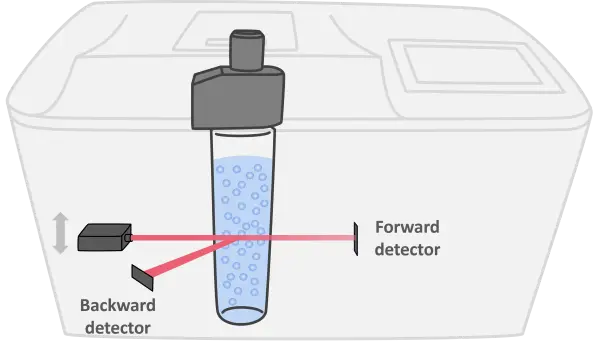
Static Multiple Light Scattering (SMLS) is an optical method for characterising a sample's stability without changing its initial state. In the BeScan Lab+, an 850 nm near-infrared LED and synchronized transmission and backscattering detectors track optical-signal changes along the sample height over time. Two detectors are available:
- For concentrated or opaque samples, a backward detector captures backscattered signals.
- For diluted or transparent samples, a forward detector captures the transmitted signals, which are then used for stability analysis.
Dispersion stability and Sedimentation analysis
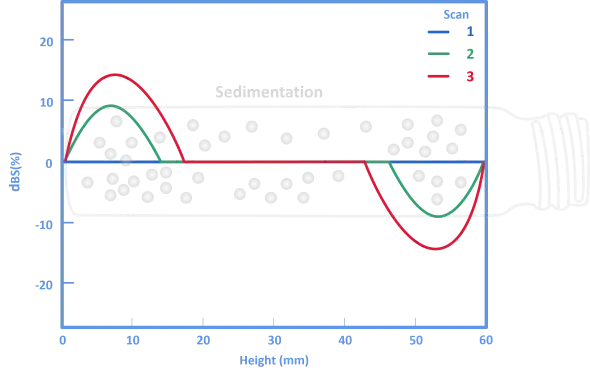
Measuring scattered-light intensity in transmission and backscattering makes it possible to analyse highly concentrated systems and identify phenomena such as sedimentation, creaming, flocculation, coalescence, aggregation or phase separation. The sample is scanned repeatedly over its full height to detect changes in transmission/backscattering as a function of height and time. With a 20 µm resolution, destabilization is detected far faster than by eye. Analyses from 10 °C below ambient (with the optional cooling module) up to 80 °C can accelerate destabilization, and measurements can follow a temperature ramp.