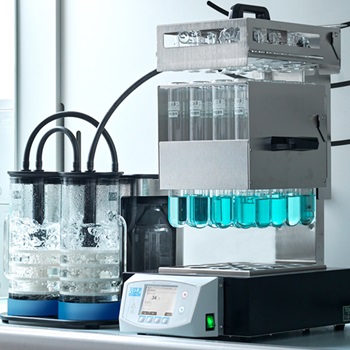
What is the Kjeldahl Method for Nitrogen Determination?
Historical Background
Nitrogen determination has a long-standing history in analytical chemistry.
The Kjeldahl method was first introduced in 1883 by Johan Kjeldahl during a meeting of the Danish Chemical Society.
At the time, Johan Kjeldahl was the laboratory manager at Carlsberg and was tasked with scientifically studying beer production processes. While investigating proteins during malt production, he developed a method to determine nitrogen content that was faster and more accurate than existing techniques.
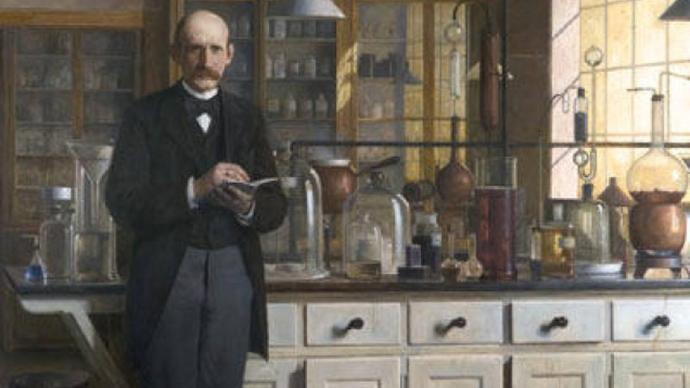
Portrait of Danish Chemist Johan Kjeldahl (1849-1900) by Otto Haslund (1842-1917) Original color painting located in the boardroom of the Carlsberg Laboratory, Copenhagen. Photo: Wikimedia Commons.
Total Kjeldahl Nitrogen: A Versatile and Reliable Method
Kjeldahl analysis is highly versatile and suitable for a wide range of matrices, including:
- Food & feed: grains, meat, fish, milk, dairy products, fruits, vegetables
- Beverages
- Environmental samples: soil, fertilizers, water, wastewater, sludge
- Chemical & pharmaceutical industries: paper, textiles, rubber, plastics, polymers
This versatility makes Total Kjeldahl Nitrogen (TKN) a reference method across multiple regulated sectors.
TKN in Environmental Analysis
Total Kjeldahl Nitrogen (TKN) represents the sum of organic nitrogen, ammonia (NH₃), and ammonium (NH₄⁺) in soil, water, and wastewater samples.To calculate Total Nitrogen (TN), nitrate-N and nitrite-N concentrations must be determined separately and added to the TKN value.
Today, TKN is a mandatory parameter for regulatory reporting in many water treatment facilities.
TKN and Protein Determination
In food analysis, TKN is commonly used as a proxy for protein content.
Protein concentration is calculated using a nitrogen-to-protein conversion factor (N-factor), which depends on the protein source.
Typical conversion factors include:
- 6.38 for dairy products
- 6.25 for meat, eggs, and corn
- 5.70 for wheat flour
- 5.46 for peanuts
Despite variability, these factors fall within a relatively narrow and standardized range.
Kjeldahl Nitrogen Analysis: Working Principle
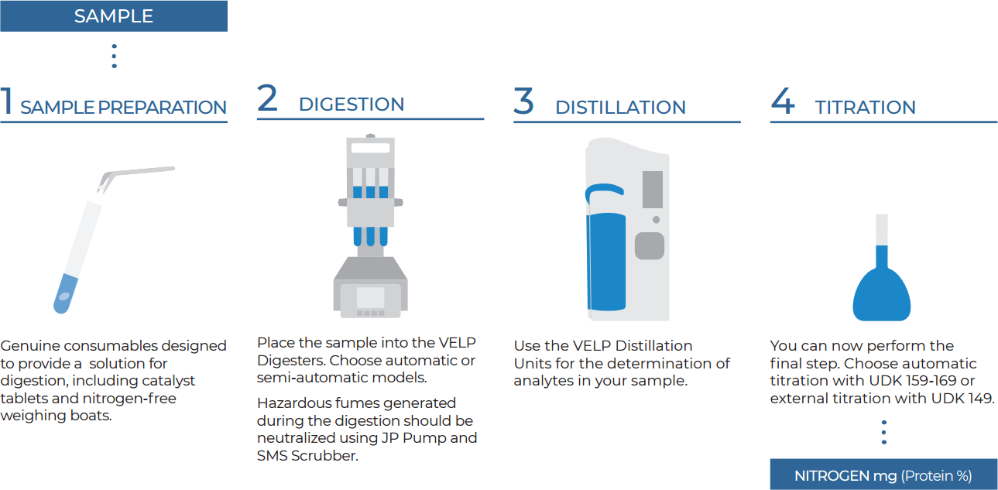
1. Digestion
During digestion, complex organic nitrogen compounds are broken down into simpler molecules, ultimately forming ammonium sulfate.
This process is accelerated by high temperature, acid, salts, and catalysts (selenium, copper, titanium).
Vapors released during digestion are aspirated via a suction cap using a recirculating water vacuum pump and neutralized in an SMS scrubber, ensuring operational efficiency and equipment protection.
Digestion is the most time-consuming step of the Kjeldahl method.
2. Distillation
Ammonium sulfate is converted into ammonia gas, which is distilled and captured in an acidic solution, forming ammonium ions.
Standard Kjeldahl distillation does not detect nitrates or nitrites. To include these forms, a pre-reduction step using Devarda alloy is required.
VELP Kjeldahl distillation units offer automation levels ranging from basic distillation to fully automated systems with automatic reagent addition, residue aspiration, and integrated titration.
3. Titration
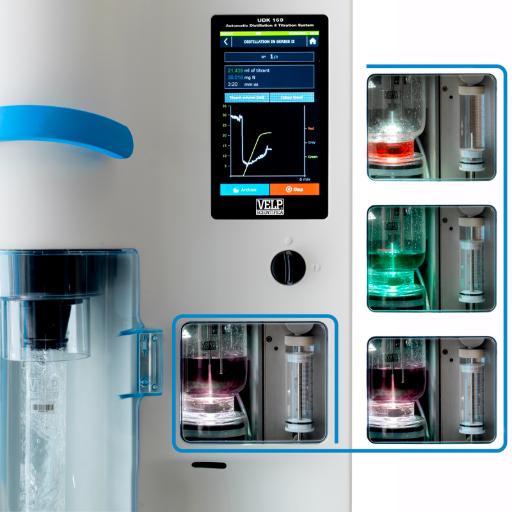
Titration quantifies the amount of ammonia collected, allowing calculation of Kjeldahl nitrogen or protein content (%).
Titration options include:
- Manual titration (UDK 129, UDK 139)
- Automatic potentiometric titration (UDK 149)
- Automatic colorimetric titration (UDK 159, UDK 169 – AOAC recommended)
Standards and Compliance
The Kjeldahl method is approved by major international organizations, including AOAC, ISO, EPA, AACC, and AOCS.
All VELP Scientifica Kjeldahl instruments comply fully with these standards.
Comprehensive Kjeldahl Solutions for BeLux Laboratories
A complete range of Kjeldahl digestion, distillation, and titration systems is available in Belgium and Luxembourg, supporting laboratories in food, feed, environmental, chemical, and pharmaceutical sectors.
Both semi-automatic and fully automated solutions are designed for high accuracy, regulatory compliance, and reliable TKN and protein analysis in demanding analytical environments.
Automatic Digestion Units
|
Model |
Positions |
|
8 |
|
|
12 |
|
|
20 |
|
|
42 |
Accessories for DK and DKL series
|
Model |
|
KS 1000 Scrubber is designed to neutralize toxic fumes produced during mineralization. |
Automatic Distillation and Titration
|
Model |
Titration |
|
Colorimetric + Autosampler |
|
|
Colorimetric |
|
|
Potentiometric |
Semi-Automatic Distillation
|
Model |
Our products
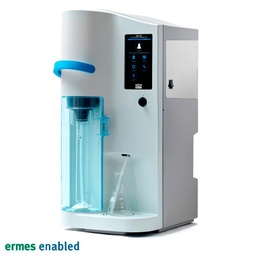
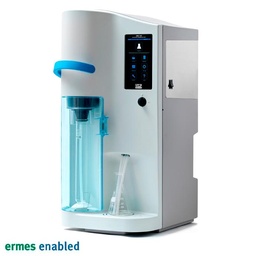
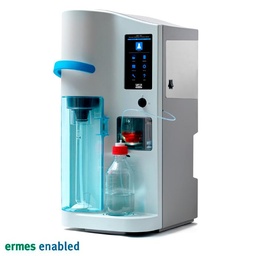
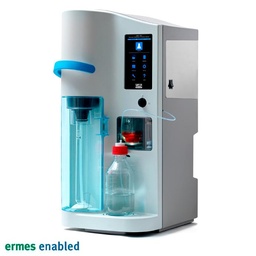
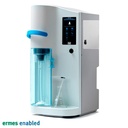
The UDK 139 is a convenient and reliable solution for safe, semi-automated distillations. The perfect distiller for laboratories looking for precise and reproducible results of Kjeldahl nitrogen TKN, proteins, ammoniacal nitrogen, nitric nitrogen (Devarda), TVBN, sulfites, phenols, volatile acids, cyanides, and alcohol content.
The Kjeldahl distillation unit UDK 139 combines excellent value-for-money with high reliability and advanced performance.
- The semi-automatic process ensures efficient operations
- Programmable water and sodium hydroxide addition
- Selectable steam generation output level 10% – 100%
- Auto removal of residues from sample tube
- Clear and intuitive operations thanks to the Smart User Interface and digital display
- Maximum safety for the operator
- Unmatched flexibility with a wide accessory range
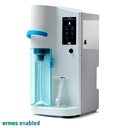
The UDK 149 is designed for maximum versatility and reproducible results when determining Kjeldahl nitrogen TKN, proteins, ammoniacal nitrogen, nitric nitrogen (Devarda), TVBN, sulfites, phenols, volatile acids, cyanides, and alcohol content.
UDK 149 can be used in combination with several models of external potentiometric titrators for higher sample throughput and direct output of the final result.
- Connection to various external titrators for automated processing and efficient operations
- Premium result accuracy and precision
- Programmable boric acid, water, sodium hydroxide addition
- Selectable steam generation output level 10% – 100%
- Auto removal of residues from sample tube
- Clear and intuitive operations thanks to the Smart User Interface and digital display
- Maximum safety for the operator
- Unmatched flexibility with a wide accessory range
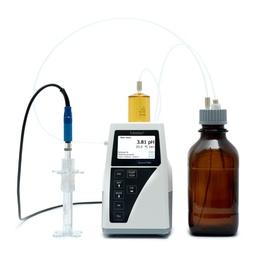
Illustration bellow showcase the combination of UDK 149 Automatic Kjeldahl Nitrogen Protein Analyzer (Reference: VEL-F30200145) together with TITROLINE 5000 Automatic titrator (Reference: VEL-R30800194):
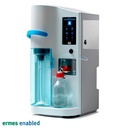
The UDK 159 is designed for high-throughput laboratories looking for precise and reproducible results of Kjeldahl nitrogen TKN, proteins, ammoniacal nitrogen, nitric nitrogen (Devarda), TVBN, sulphites, phenols, volatile acids, cyanides, and alcohol content.
- The fully automatic process ensures efficient operations, distillation and titration performed simultaneously
- Shortest time-to-results with online titration and automatic results calculation
- Premium result accuracy and precision thanks to the integrated colorimetric titrator with high precision burette
- Programmable boric acid, water, sodium hydroxide addition
- Selectable steam generation output level 10% – 100%
- Auto removal of residues from titrator & sample tube
- Clear and intuitive operations thanks to the Smart User Interface and digital display
- Maximum safety for the operator
- Unmatched flexibility with a wide accessory range
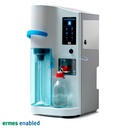
The UDK 169 is designed for high-throughput laboratories looking for precise and reproducible results of Kjeldahl nitrogen TKN, proteins, ammoniacal nitrogen, nitric nitrogen (Devarda), TVBN, sulfites, phenols, volatile acids, cyanides, and alcohol content.
UDK 169 can be used in combination with the AutoKjel autosampler, for a highly productive system capable of autonomously processing sample tubes, which are fed directly into the fully automatic distillation and titration unit.
- The fully automatic process ensures efficient operations, distillation and titration performed simultaneously
- Shortest time-to-results with online titration and automatic results calculation
- Premium result accuracy and precision thanks to the integrated colorimetric titrator with high precision burette
- Programmable boric acid, water, sodium hydroxide addition
- Selectable steam generation output level 10% – 100%
- Auto removal of residues from titrator & sample tube
- Clear and intuitive operations thanks to the Smart User Interface and digital display
- Maximum safety for the operator
- Unmatched flexibility with the autosampler and a wide accessory range
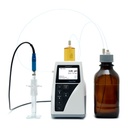
The TitroLine® 5000 is a very compact titrator for simple routine titrations.
Thanks to the standard methods the creating of methods is no longer required. Just load the method and press the start button. GLP compliant results can be documented on a connected printer or USB-memory stick. Connection to various external titrators for automated processing and efficient operations.
- Color display that can be easily viewed from a distance and at extreme angles.
- Export the results as PDF or CSV on USB sticks.
- Pre-installed standard methods
Following titration modes are possible:
- Titrations to pH, mV - endpoint (2 EP)
- Titrations to one equivalence point (pH und mV) with dynamic or linear titration addition
- Manual titrations with the controller
- Dosing tasks
- Number of methods: 5
Typical applications for the TitroLine® 5000 are:
- Salt content in foodstuffs (cheese, soy sauce, ketchup)
- pH-value, total acidity in wine and beverages
- Acid value in bread and bread dough
- Total nitrogen according to Kjeldahl
- Chloride in drinking water and other samples
- pH-value, Alkalinity (p + m-value)
- FTA/TA („FOS/TAC“)
TitroLine 500 Automatic titrator Includes:
- 10006572 TITROLINE 5000 230V
- 10000284 Rod Stirrer TZ1847
- 10000285 pH Combination Electrode N61
- 10000286 Plug Cable Combination K1A
- 10000287 Stand Rod (145) SA TZ 1510
- 10000288 PTFE Ground-in NS 14,5 TZ 1520
- 10000289 Titration Vessel (200) TZ1759
- A00000211 Connection Kit Schott RS232
- A00191223 Power supply x Schott mechanical stirrer